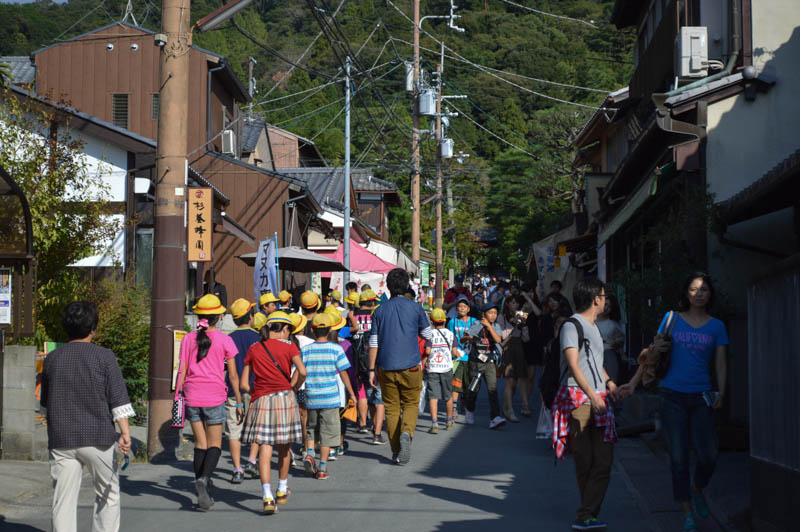
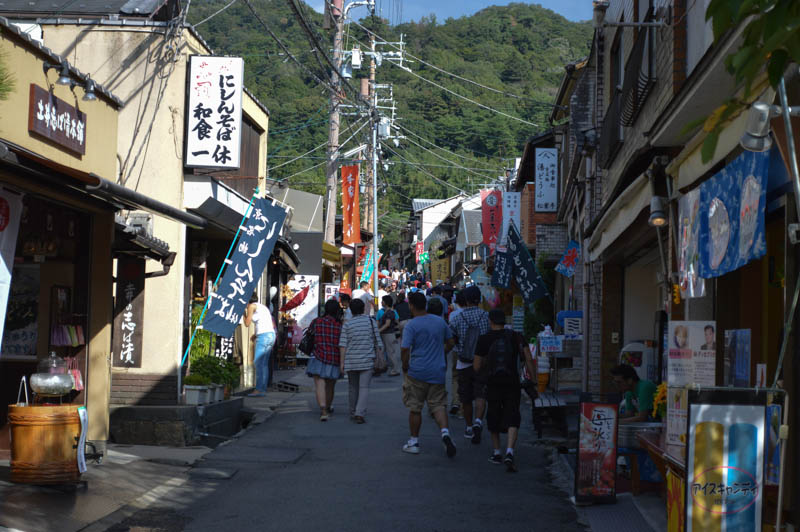
We hopped into a bus and continued our temple journey to the mountainous eastern Kyōto (Northern Higashiyama District). Walking away from busy Imadegawa Dori, we entered a narrow Ginkakuji- cho. This street was crowded with pedestrians, mainly kids on a school trip. The street was lined with restaurants, souvenir and retail shops. The road led uphill towards a lush mountain. The sounds of kids chatting away, with a cheerful attitude, curiosity and innocence, created a heart- warming atmosphere. Ice cream parlours and fruits drinks outlets had queues of people lining up. The sun, although hidden, radiated much heat and it was humid.
We entered a narrow passage, “Ginkakuji-gaki”, lined with tall trees, and entered through the So-mon Gate. The street had tidily trimmed hedges on both sides, and a neat bamboo fence. We then entered the Chu-mon Gate. It was crowded today. The views opened up with contrasting sand and gravel against lush mountainous greenery. A two storey dark exterior, “Kan’non- den”, commonly known as Ginkaku, the Silver Pavillion, is set amongst tall pines and landscaped lake and garden. This was built as a retirement villa for Ashikaga Yoshimasa, a shogun, in 1482 and later converted to a Zen temple in 1490. He modelled it after Kinkakuji (the Golden Pavilion) in Kyōto’s northern mountains. The pavilion was never covered in silver.
“The entrance to Ginkakuji was a long street, packed with people and shops everywhere. It felt like I was back in Magome!” – Navindd
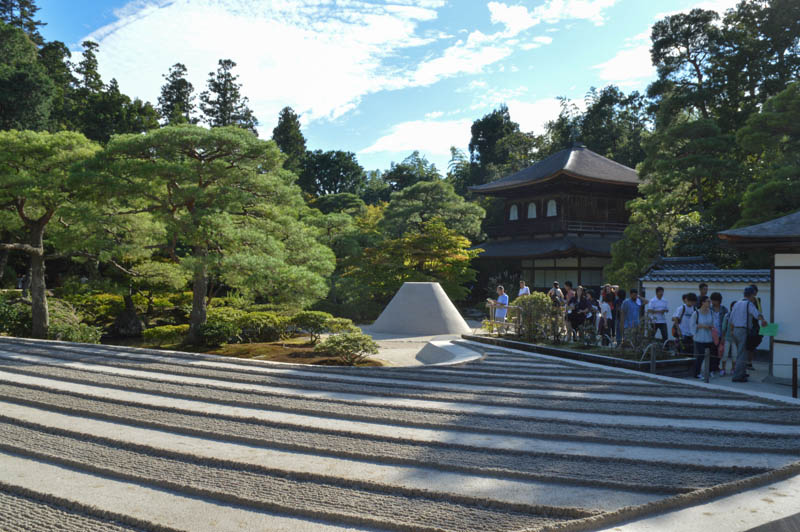
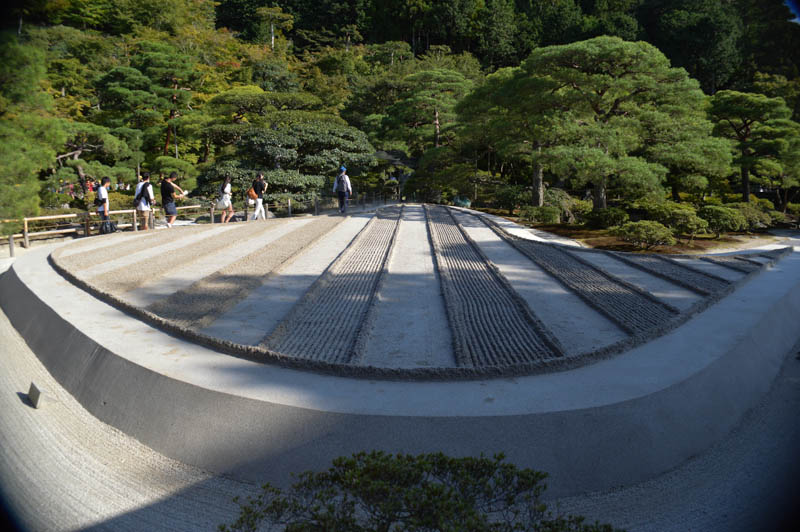
 Next, we came to an expansive dry sand garden with a rather large truncated cone, 2m high, made with fine white sand, “Kogetsudai”, Moon Viewing Platform. It stood out against the raised and raked coarse sand, “Ginshadan”. Kogetsudai is said to resemble Mount Fuji amongst others. On full moon nights, the moonlight is reflected onto the “Ginkaku”, Silver Pavilion. Magnificent greenery surrounded the “karesansui”, dry garden, and the beautifully architectured building flanking the “Sea of Silver Sand”, including the “Hondo”, Main Hall and “Tōgudō” which are national treasures. A wonderfully landscaped pond, “Kinkyochi”, the Brocade Mirror Pond, with large sculpture pine trees leaned towards the pond and hugged this dry sand garden and the adjacent buildings. This pond is punctuated with islands connected by stone bridges. Ginkaku-ji’s “chisen- kaiyushiki”, pond-stroll garden, was also modelled after the garden of Saiho- ji. A moss garden appeared under the shades next to the pond. A nearby small waterfall, “Sengetsu- sen”, Moon Washing Falls fed this pond. The water is continuously replenished.
A meandering path crossed stone bridges, past moss covered gardens and flowing ponds, as it continued uphill. Looking back towards the majestic “Ginkaku”, Silver Pavilion, reflected on the “Kinkyo-chi” pond, I can easily imagine the tranquillity derived from these surroundings.
Islands and stone bridges had their own colourful names. Shadows of trees and buildings reflected off the clear water of the pond created a surreal and vivid appearance. With the ever changing light, although cloudy today, the dramatic views continuously changed. Perhaps reflections of our own lives are represented here!
“The temple was also famous for its 2m high sand cone, which sat perfectly on the side of one garden, with not a single mark on the sides……..the Silver Pavilion…trees surrounded it and it seemed to be floating on the pristine green pond….It was worthy of a front page of any travel book. Inside the pavilion though, there was nothing much. It was just an empty room” – Navindd

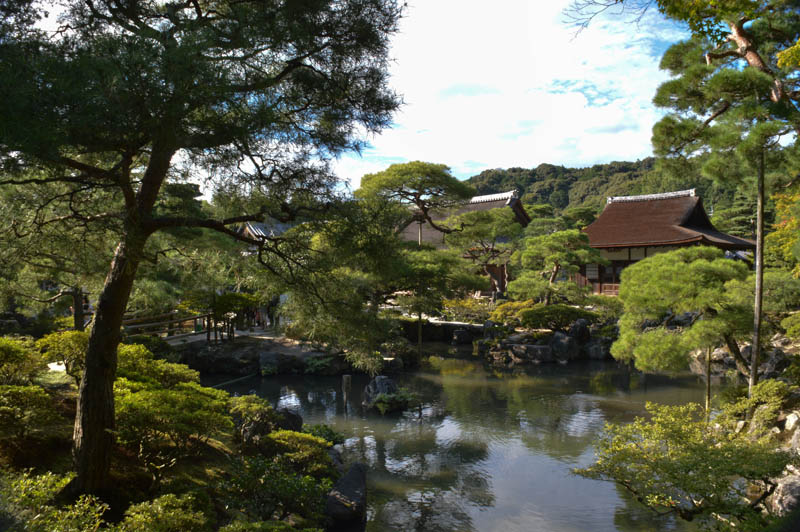
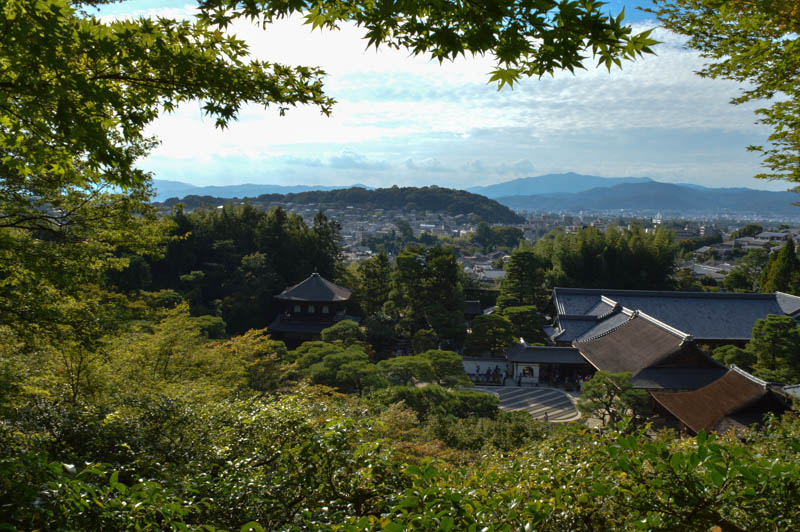
The path wound uphill surrounded by a mixed forest. Numerous maple trees were scattered around this forest. Moss covered vast areas of the shaded ground under the forest canopy. I could imagine the dramatic autumn colours of the expansive temple grounds. From the hill top, there was a lovely scenic view of the temple complex with a backdrop of Kyōto. The usage of minimum natural elements such as sand, stones, water and plants; strategically placed allowed us to see different perspectives as we strolled around this tranquil landscape. It is not hard to understand the immense pleasure that can be gained with simple things. Ginkaku- ji does just that!


 Intrepid Nomad - Travel Tales and Stories