Category Archives: Cuba

havana2

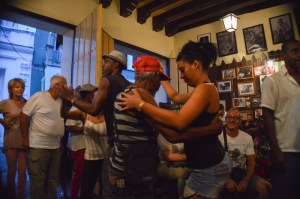
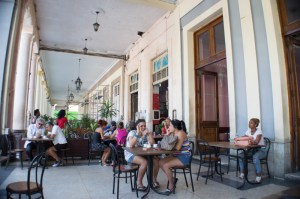
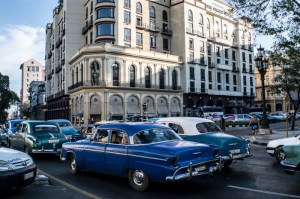
At the end of Prado, a cluster of magnificent buildings appeared. One was Gran Teatro de La Habana, an architectural masterpiece. I was very impressed by its details. A row of restaurants were on the ground floor. My tummy was grumbling in the late afternoon. I entered a patisserie – Pastelaria Francesa. The interior wall was pink and the waiters and waitresses dressed in black and white. The display cabinets had a selection of cakes, sweet and savoury pastry and great smelling coffee. It was busy, however, the atmosphere is wonderful. Service is mediocre but pleasant. Armed with two pastel de guayaba (sweet guava pastry), I managed to get a table outside on the corridor. This is a great place to watch the daily lives on the main street and catching the actions across the Central Park. The street is crowded with taxis, horse- carts, and the iconic beat-up American cars. Some in bright gleaming colours with open tops enticing tourists to take a ride. Salsa music wafted through the humid and tropical air. Musicians played catchy Son and salsa tunes to the delight of tourist and locals a few doors away in the building, at Hotel Inglaterra. Although the food here is average, I loved the relaxed pace, convenient location and reasonable prices. Unfortunately, you are also exposed to “jineteros“, street touts.
havana (4)

havana (43)

I met Alexis at the cafe. He spoke Spanish to me only to realize that I was not a local. He thought I was a “Cubano“, a Cuban, likely from Baracoa, a far eastern town dominated by Afro-Caribbean people, being dark-skinned. Strangely he did not enter into the cafe. A street hustler perhaps or wanting something I thought. Before he continued, I asked him if he wanted to sell or want something from me. If yes, please go away but if you want to talk, that’s fine. I am not one to shun from a conversation. He spoke little English. When popped the question of Cuba opening its doors to the Americans, he was sceptical. This is the reason for my travel to witness Castro’s Cuba before it changed for better or worse.  Alexis wanders off.

I belief, with the imminent relaxation of US trade embargo sanctions, the cost of living will go up as new imports are allowed in. Wages will take time to catch up especially for the State employees.  The upper and middle class, and those involved in the tourist industries will benefit the most. The have and the have not’s at the onset. More importantly, the State policies governing socio-economic has to change. Overall, with the relatively poor living conditions, it doesn’t seem good in the short-term. Time to explore Old Habana, “Habana Vieja“.
havana (8)

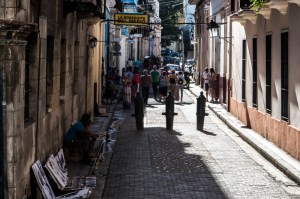
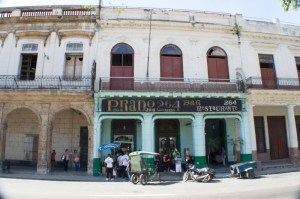
Walking is the best way to explore this part of town. Paseo de Marti roughly separated Centro Habana and Habana Vieja. As I strolled along the narrow streets, its derelict and tired-looking facades of buildings remain elegant and with lots of old-world charm. Balconies, arches and pillars appealed to me. On a street in Centro Habana, I met Angelo, a fairly white bici-taxi (a three-wheeled Pedi cab) driver. He spoke good English. He was trained as a MRI technician and earned about 20CUC per month. He left school at fourteen to provide for his family.  After the revolution life became difficult for the family. When sanctions were imposed, his father couldn’t cope to provide and committed suicide.  His sister drowned while desperately fleeing the country. He had to care for his mother. Initially renting a bici-taxi, he eventually owned one and is quite happy. He earned more than four times his monthly State wages. He has a wife and kids to think about. When asked about Castro, he snapped. “I hate him. Muerte“, death to the Revolution”. He was visibly disturbed. I can understand his bitterness. However, Che Guevara gets a thumbs up.
havana (25)

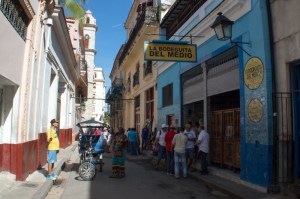
Angelo is one example of educated professionals whom have now abandoned their jobs. My casa owner is a pediatric doctor! Obviously, their income is much higher. This phenomenon will continue to become wide-spread with the removal of the trade sanctions. Will this bring about shortage of skilled personnel to build up the country later? Most Cubans are employed by the State (paid in Moneda Nasional) and for those whom need more, just to survive, there are no options but to get involved in tourist related activities. The real money, CUC, becomes available. I decided to take a ride with Angelo on his bici-taxi for 3CUC. It is quite a sum to pay (compared to what locals pay) but it was more the company. We ended up at Hemingway’s mojito joint, La Bodeguita Del Medio on Calle Empedrado. For obvious reasons, the place was packed with people wanting expensive mojito’s.
Havana 1

It was nearing midday when I arrived at Jose Marti Int. Airport in Havana, Cuba. Immigration formalities were smooth apart from being scrutinized for a few minutes by a police officer. At Immigration I handed my passport and my “tarjeta tourista” or tourist card. I understood that all tourist needed one before arrival. I diligently managed to get one from Copa Airlines at Santiago (at a cost of US$20). I was relieved. To my surprise, the tourist card was returned. “No nesasito“. Well at least not for Malaysian passports. There were no visible signs of police presence nor heavy inspections of luggage. It was a normal entry.

Next was to obtain some local currency. I brought Euros (as there was a 10% commission on US dollars.) The local tourist currency is Cuban Convertible Peso (CUC) at nearly 1: 1 rate (today was 1: 1.18). I was greeted by Julian (my “casa particular” owner) not with the iconic beat-up American cars but a small sky blue Fiat. The drive from the airport was with some kind of unknown or unexplained expectation. I travel with no expectation to all countries as this enables me to accept whatever is thrown at me. A new experience. However, Cuba had been in my mind for a very long time. I hold Cuba both in empathy, triumph, the romance of the revolution and the heartache of big brother bullying.

I had travelled to a few countries but not quite excited as travelling to Cuba. A country that had been “moth-balled and placed on a shelve”, and cordoned off for 50 odd years. There were questions but the response were unreliable. I had waited a long time to arrive here. It wasn’t the iconic cigars nor the promise of idyllic beaches but of the wonderful mix of African-Indian-Caribbean-Spanish cultures, music and perhaps to understand a little of the lives of the people. More importantly, to see and experience the “cocoon of post revolution Cuba” – Castro’s Cuba. Post 1959, Cuba is best describes as a socialist with the state controlling most of the economy, production and employment. The best way to find out is to personally explore and experience this idyllic Caribbean, multi-ethnic, customs, people of diverse origins.

The 25CUC (perhaps a tourist price) drive was challenged with a few pot holes in a very tropical setting. Coconut trees are a giveaway. I felt like I was home (Malaysia). There were very few road vehicles. The drive through Central Havana was eye-opening. I was greeted by tall grey blocks of Soviet-era buildings.  Concrete blocks in a dilapidated state. Perhaps one or several coats of paint might change the uncharacteristic building blocks.

havana (1)

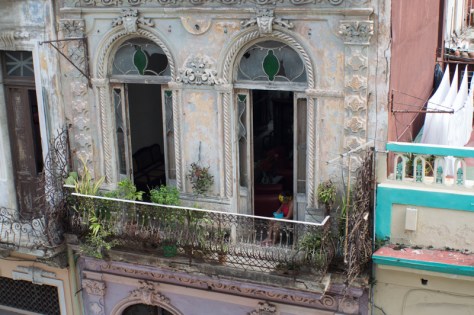
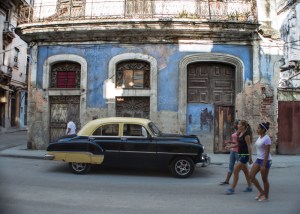
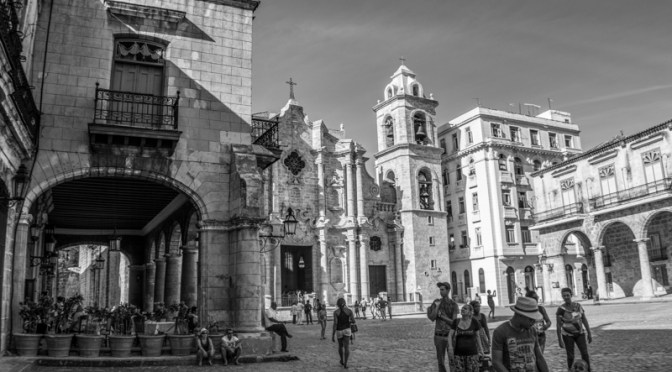
As we approached the narrow streets of Centro Habana, a kaleidoscope of architecture – neo-gothic, art deco and neo-classical. Villas, mansions, low apartment blocks with balconies, mostly in pastel colours all crumbling, faded and at various state of dilapidation were on display. On the road, classic American cars brought over in the 50’s mingled with Soviet- Balkan era and Japanese cars. Many, possibly functioning on borrowed times.

havana (82)

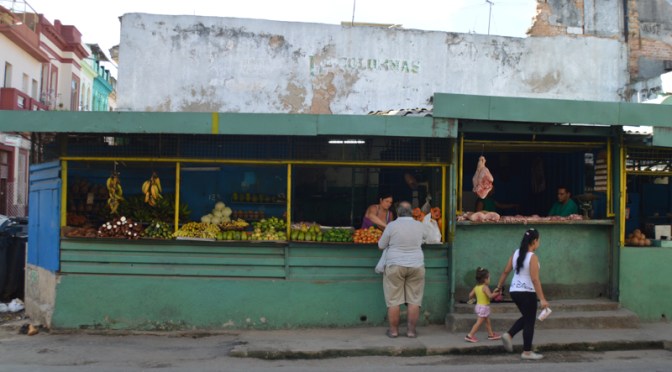
There are basically two options of accommodations, legally, – Hotels and Casa Particulars. To get a near authentic and cheaper option, I choose a Casa Particular. They cost around US$20 – US$25 and meals are optional and cost extra. My Casa Particular, in Centro Habana, has all the modern amenities plus running hot water, internet and look well-off. These accommodations are approved by the State, privately owned and managed with a blue symbol, “arrendador divisa“, visible on the front. Perhaps slightly costly for backpackers, but it provided a homely experience and with plenty of local information. With increased relaxation of State control and expansion of private business, numerous Casa Particulars have sprung up throughout Habana and other tourist destinations. My Casa (an associate of my booked Casa) was on the third floor (with an internal working lift) in a two bedroom low-rise apartment block. My room had a fabulous views of Centro Habana and Habana Vieja (Old) Habana. Casa owner Miguel was a quiet elderly man and spoke only Spanish. A small vegetable market with corrugated iron roof on the street corner was doing little business. The assorted produce were all fresh.

My Casa in Centro Habana, on Calle Consulado, was one block off the wide and leafy boulevard, Paseo del Prado. Alternatively referred as Paseo del Marti which stretched from the coastal coastal Malecón  and Castillo de San Salvador de la Punta to Calle Neptuno, off the Parque Central. I was eager to explore.

havana (36)


havana (100)

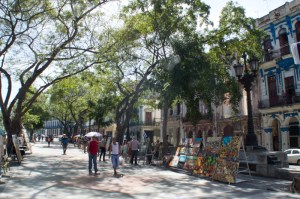
On the Prado, under the canopy of trees, paintings and drawings by local artist depicted daily Cuban life in oil, paint and pencil, were displayed of wooden stands. Little kids, probably between 8 – 10 years old, were mentored by adults in the instilling interest and knowledge in art as they begin to put their impressions of Habana on paper. On the road, classic American cars mingled with Japanese cars. The people I met on the streets were friendly. Buses and cars alike puffed out diesel filled choking black fumes.

Havana
Havana

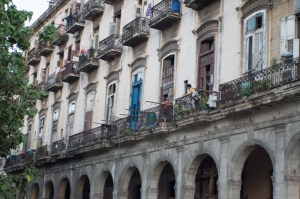
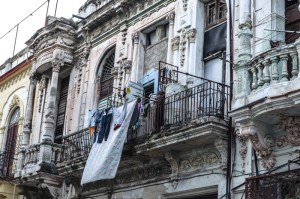
Rows of low-rise apartment blocks stretched on both sides of this wide and green road. The exterior of these blocks revealed ornate designs, wonderful and colonial architectures. People stood of balconies having conversations and clothing hung to dry fluttered slightly in the hot breeze. I was excited with my journey through Cuba, enchanted or not, I shall soon find out.

Cuba

Journey undertaken in October 2015

Cuba had been on my ‘want to be there places’ simply to witness the harsh reality of politics. The Republic of Cuba with over 4000 islands in the Caribbean Sea has a population of about 11 million. The Spanish colonized in the 15th century. In the late 1800’s, it fell into American control. Then in early 50’s, it fell into the hand of Batista, a dictatorship government. Apparently the American mob had a free hand in running things, gambling, drugs and prostitution, in Havana. After the Cuban Revolution of 1959, in association with Che Guevara, Fidel Castro overthrew the existing government and eventually established a socialist/ communist government.  However, the US placed a trade embargo on Cuba after the failed Battle of the Pigs to overthrow Castro, the Missile Crisis and Cuba’s association to the then Soviet Union. The US did not like this. Things were looking good for Cuba at this stage. In the late sixties, the Soviets, the major importer of Cuban produce like sugar propped up the economy.

hav15

As a result of the sanctions and withdrawal of the Soviets, hardships befell to the State and the people of Cuba. Money become scarce. Castro’s communist or socialist government had to survive with little. So change and development halted. The once thriving agriculture production declined. This situations had created a country where time literally stood still. Cuba is living in the sixties. From the buildings, cars, agriculture and food, all become “rare” commodity. Upkeep and maintenance stopped as funding dried up. The hardships had led to many Cubans to migrate at great expense (including their lives) to the US and other Latin American countries.

The revolution brought Castro into leadership but later hardship to Cuba. The revolution was never given a chance to develop largely thanks to the US trade embargo. In other Latin American countries, where there was no US trade embargo, the revolution had brought about positive changes and developments. Countries like Nicaragua. One could argue that there were still funds and income coming into Cuba, where did these monies go? Corruption perhaps and into political leaders pockets? I don’t know.  What I do know is that the people of Cuba had endured hardships for a long time and continue to do so with poor housing, infrequent basic amenities like electricity and water supply, high cost of ‘anything’ not considered basic needs. It is hard to take in watching the queues at grocery and butchery. However, what is astounding is the basic nature of the Cubans. With all the circumstances affecting their daily lives, they are hospitable, friendly and engaging. The desire to be happy is overwhelming – in their music, dance, smiles, ingenuity and everyday life. For Castro, it had been a battle between David and Goliath. All within a stone’s throw. Surely with America’s might, Cuba could have been ‘neutralized’. Castro had survived till today. In my view, Castro had worn this battle, albeit the hardship Cubans had to endure. Some with their lives. At the moment, with easing of this trade embargo, the only visible sign is an American flag flying in its embassy. This is my personal journey through Cuba.

san24