Category Archives: Japan

Nara – Kōfuku-ji Temple

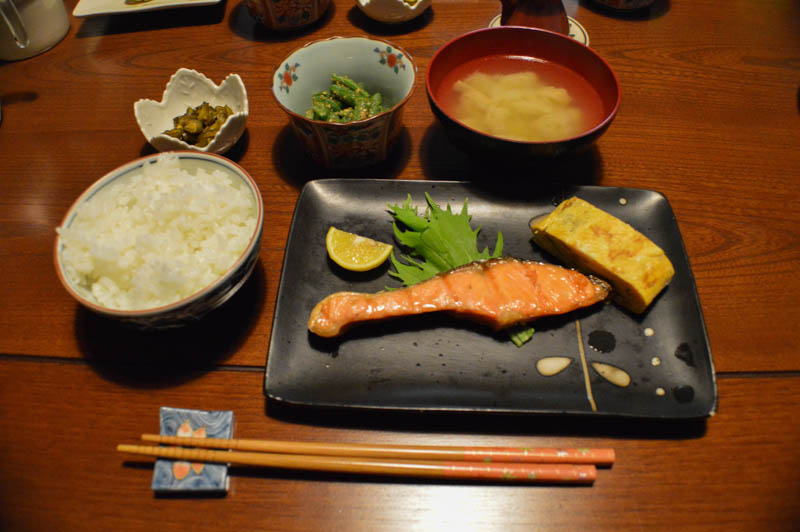
untitled-286Breakfast was provided with the booking. In the cool morning, we dined at the low table with a ‘cut out’ bottom to stretch out our legs. It was like sitting on a chair with no back rest. Steaming bowl of rice, pink teriyaki salmon, pickled vegetables, egg roll and a bowl of warm miso soup was served. A hearty breakfast indeed! It may not be everyone’s cup of tea having rice for breakfast. In Japanese culture, this is a norm. Kayoko was always attentive and asked if topping up rice and miso was required. This is a great way to start the day.
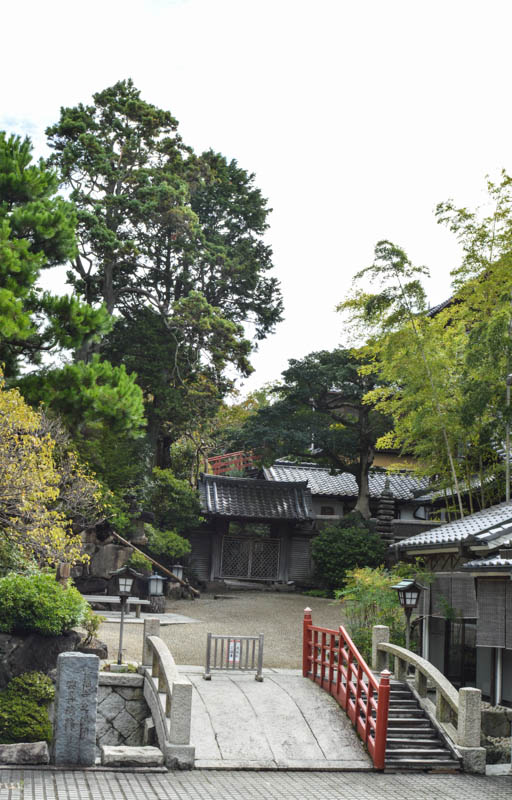
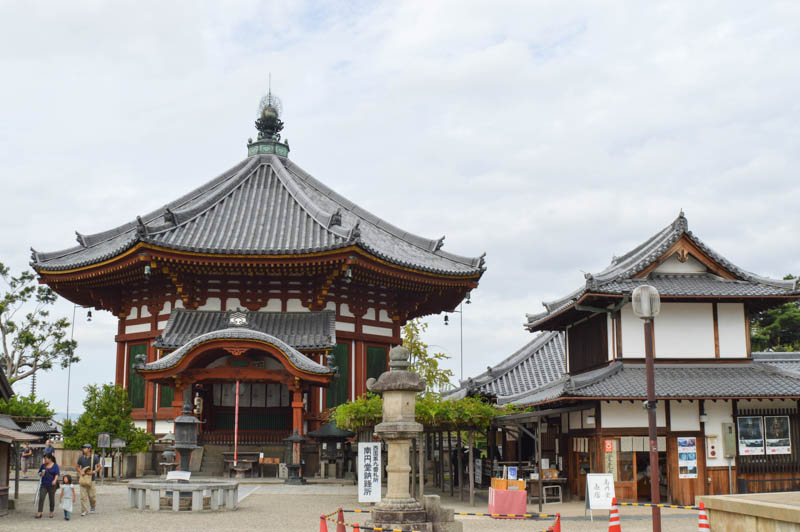
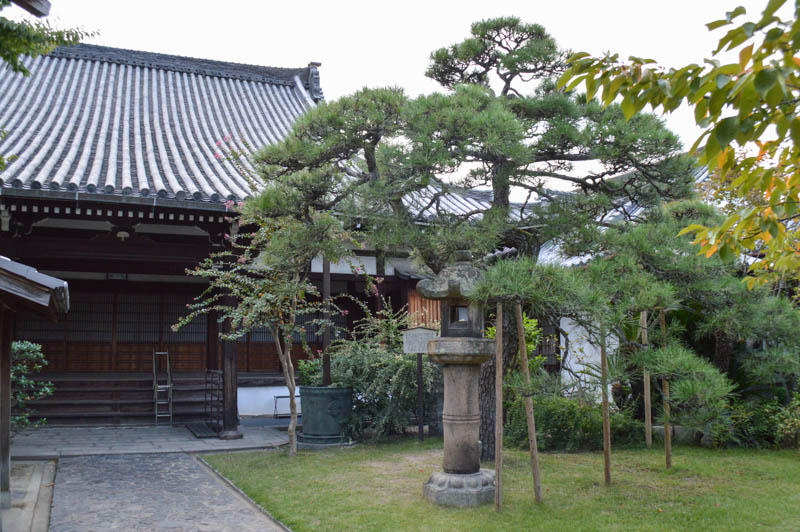
untitled-293untitled-292 untitled-294From Naramachi, we walked towards Mochidono Arcade and into one of the many side streets. There was an Indian restaurant, amongst several retail shops and eventually ended at the Sarusawa Pond surrounded with willow trees with a view of a pagoda. This is Kōfuku-ji Temple, a Hosso Buddhist Temple. Across Sanjo Dori is a steep flight of steps. At the top, on the left, is an octagonal wooden building, Nan’en- dō, and a path, on the right, towards the five storey pagoda.
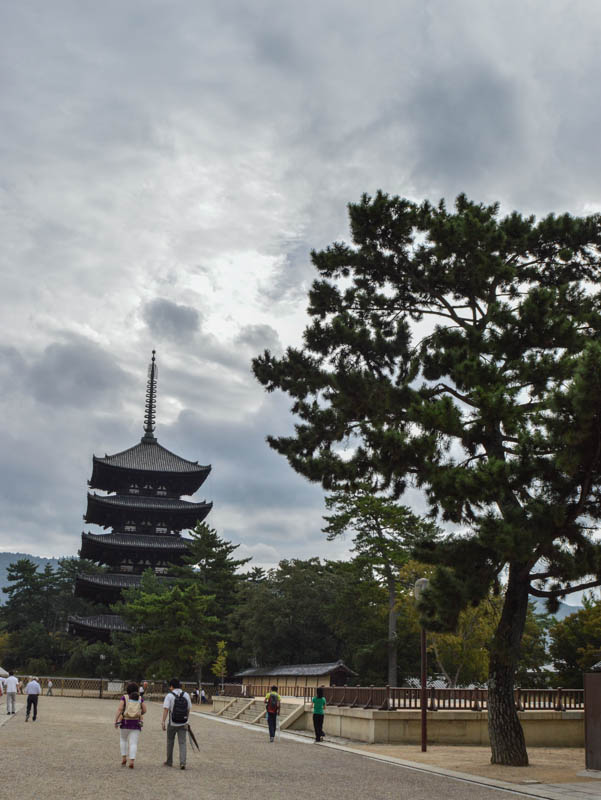
untitled-291Tall pine trees lined this wide gavel path. Kōfuku-ji Temple was established in 710AD and used by the Fujiwara clan during the Nara and Heian Period. Today, however, only a few buildings remained. It included the 50m high five storey pagoda, “gojū-no- tō”, the second highest pagoda in Japan. The enclosure was locked. Apparently a large image of the Healing Buddha, “Yakushi Nyorai”, is located here. We passed the Great Eastern Hall, “Tōkon-dō”. Further walk brought us past a huge construction site – the Central Golden Hall. Then to the Northern Octagonal Hall, “Hoku’en-dō” was originally built in 721. These pair of octagonal structures are quite unique and interesting – the architecture, and are valuable as they both hold irreplaceable and priceless national treasures.

The streets were uncrowded and the walk was pleasant. Finally we reached the green lung – Nara Park, “Nara Kōen”. One entrance is marked with a red “torii”, “Ichi- no- mochi”.

Nara – Naramichi 3

untitled-284DSC_0547

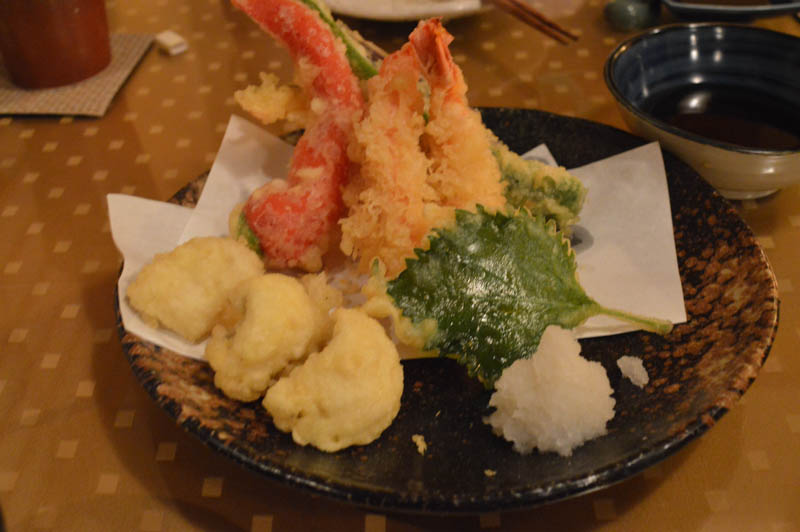
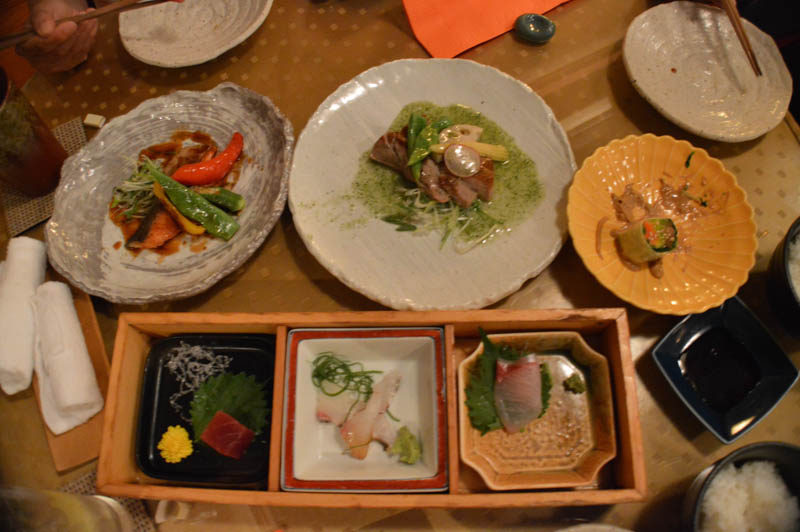
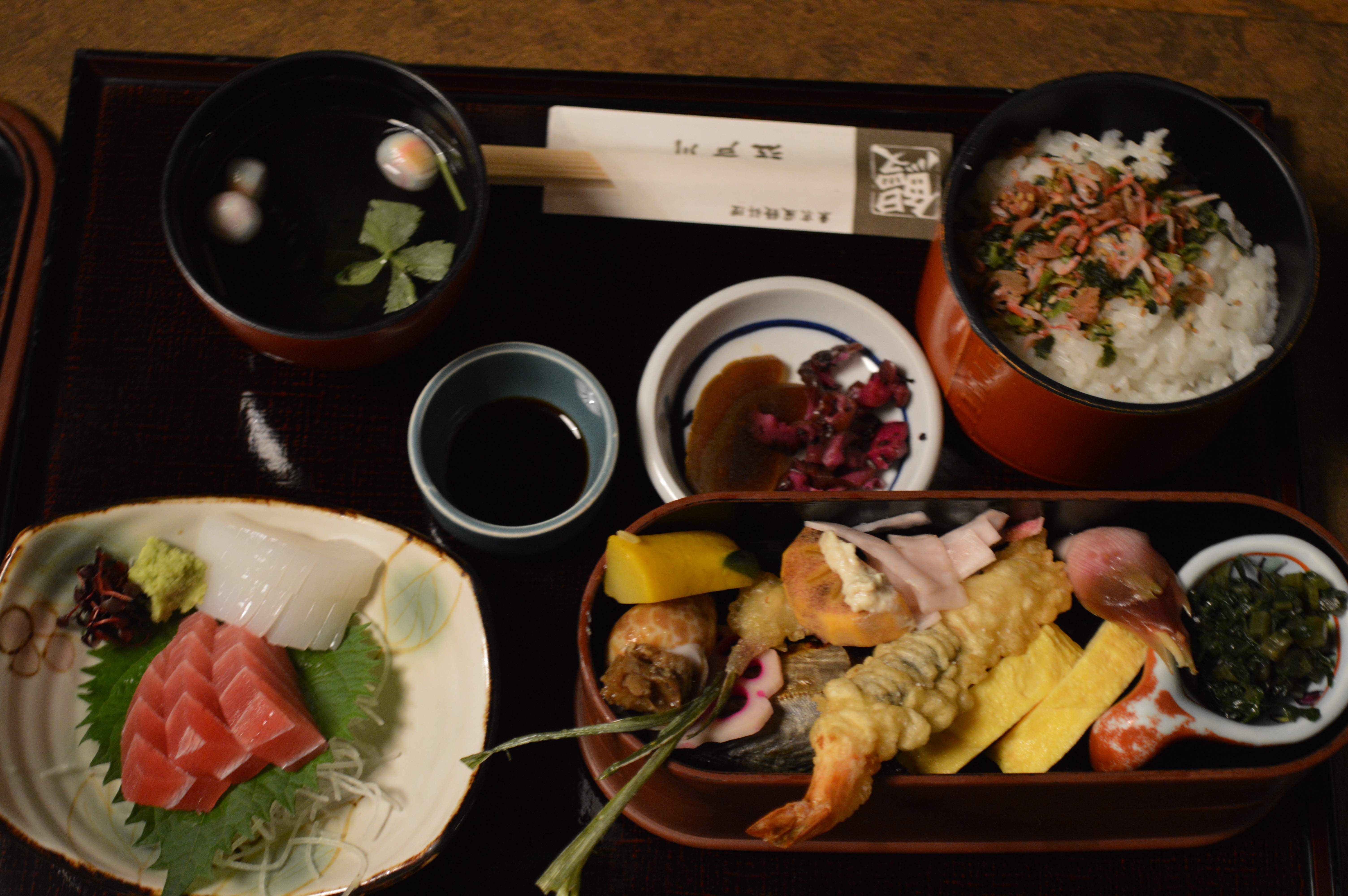
DSC_0552In the evening we decided to go to a nearby restaurant in Naramachi recommended by Kayoko. The place was busy and a hive of activity. We waited outside and eventually were ushered inside to a room with a few low tables scattered around. The interior was wonderfully by simply decorated and the dark woodwork glowed in the low lighting. The staff walked around quickly but quietly and always giving a smile. We sat at our low table on tatami floors. Prawn and vegetable tempura, steamed tofu in a delicate sauce, addictive miso soup, fresh sashimi of yellow fin tuna, “maguro” and a white fish, steamed sweet potato and ladies finger. All these served with steaming rice and a selection of local pickles – “narazuke”. That was just my dishes.

Lee Cheng had the simple eel, “unagi”, cooked with light teriyaki sweet sauce, pickles and miso with rice. Navindd ordered a platter – tuna sashimi served with daikon, battered prawn tempura, an exotic escargot (snail) which surprised us all, soft egg rolls and complemented with more assorted pickled vegetables, miso and rice topped with skipjack tuna shavings, “katsuobushi”. We loved the food in all the places we have been and this looked great too.We consumed quite a bit of the aromatic green “ocha” tea during the course of the evening.

The meal was an enjoyable way to finish a leisure day. This is our second last day in Japan. The ambient setting and the welcoming service by the staff contributed immensely to the evening. To give you an idea, the cost of our meals was about ¥8000, roughly US$85. It is definitely worth it. As we left, I noticed that the snail was left untouched. It turned out to be a great recommendation.

Back at Sakuraya, we all sat down for more tea, tasty soft biscuits and pleasant conversations. This would perhaps be the most ‘homely’ stay we have had in Japan. Finally, we snugged into our soft and comfortable futon beds.

untitled-283 untitled-289

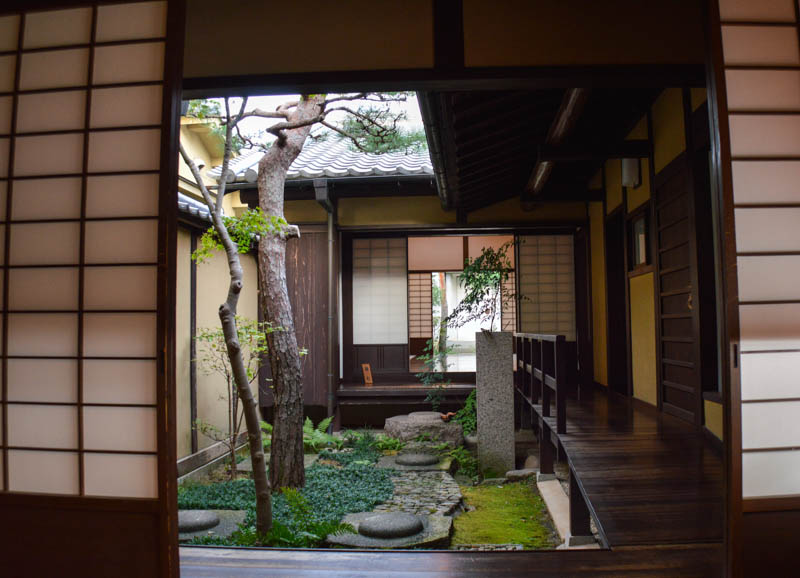
Sakuraya is “machiya” style home and has only three Japanese style tatami floor rooms. The dining hall faced the refreshing inner garden complete with water basin, palms and pine trees. Granite rocks and stepping-stones added further appeal to the rather small but delightful garden. A pair of wooden slippers were placed, pointed outwards, on a stepping stone.

Nara – Naramichi 2

untitled-278

untitled-277 untitled-280

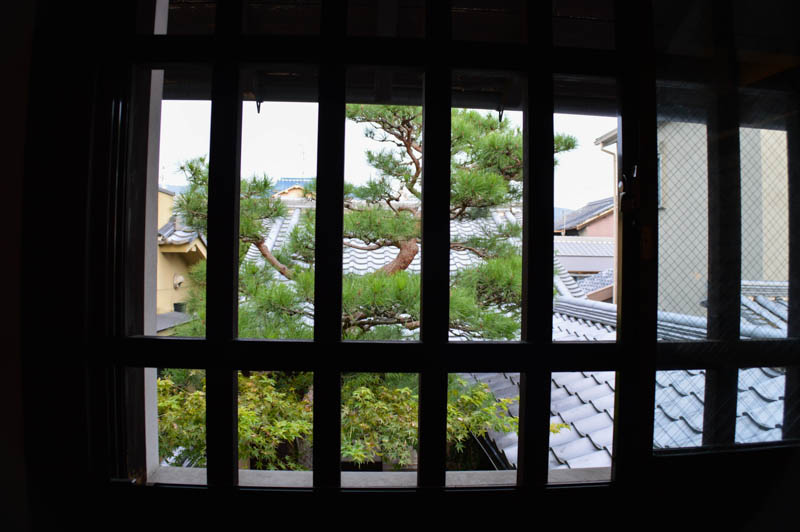
Clothing, quilted bedding and mattresses hung on lines to dry in the sun. Typical daily life continued here. However, it was strangely quiet. This is the magic and charm of this preserved Naramachi. Cosy tea and cake shops allowed time to rest and soak in the atmosphere. There are several temples and shrines hidden amongst these alleyways. Museums, sake breweries, gift shops and “onsen” are scattered in this area. One museum we visited was the “Naramichi Koshi no- le”, the Naramachi Lattice House. It is a restored traditional “machiya” townhouse of a merchant’s house. It was just past closing time but the caretaker allowed us entry. I loved the dark wood floors and staircase. There is a certain ambiance that it creates. A small but refreshing inner garden, “naka-niwa” complete with water basin and stepping stones, occupied the centre of the long townhouse. From the upper floor, the slated windows allowed for views of the tiled roofs, garden and light to enter into the rooms. At front of the house, slatted wooden lattice windows allowed for views of the street but concealed the interior.

A White gem unknown of man –
Be it so if no one knows!
Since I myself know its worth
Although no other –
Be it so if no one knows!
– a monk of the Gango-ji Temple

untitled-276 untitled-281

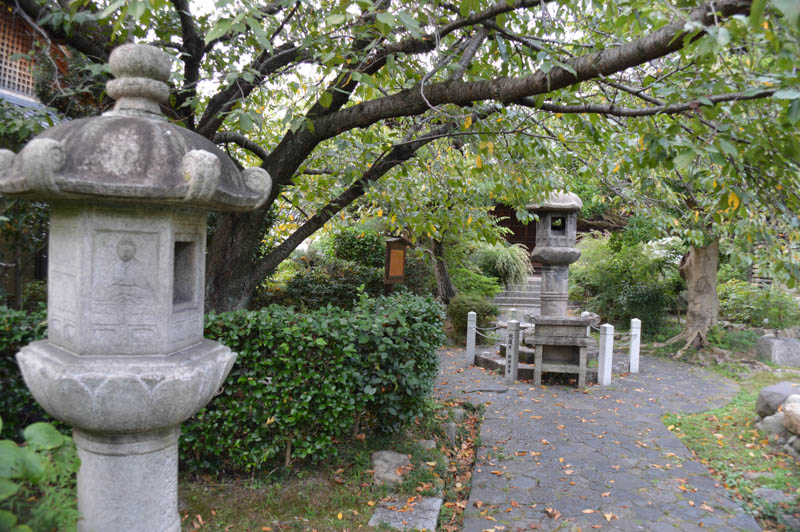
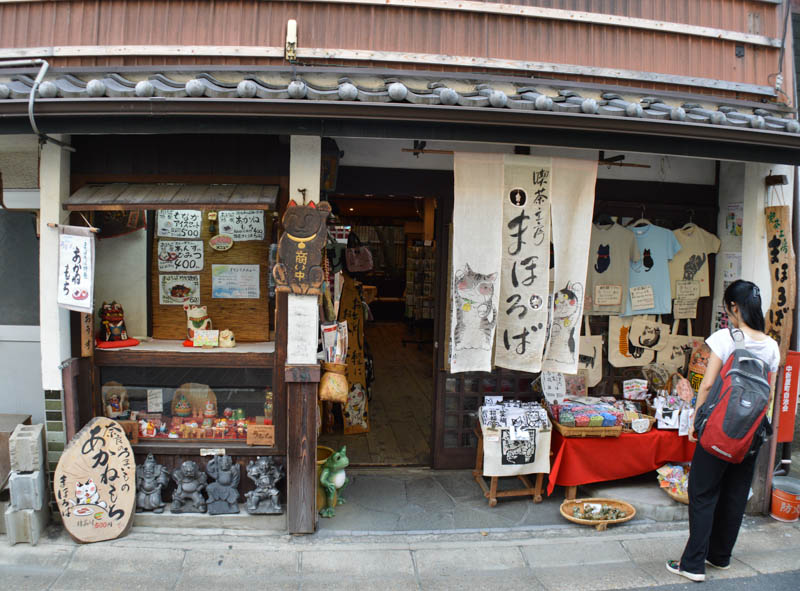
We stumbled into a temple gate. Gangō-ji Temple site used to occupy a large area in the present – day “sitamachi”, old town. We had no idea if this temple was part of that former complex. It was a serene site with large trees and well-kept grounds. A few stone lanterns decorated the place. An ornate stone footprint lay at the base of an aged tree surrounded by buttress roots. At another street, we entered Toku- ji Temple. These are little surprises we encountered as we strolled aimlessly in Naramachi. Tourist shops are always exciting – little mementos and gifts to take home. We found a “noren” maker at a street corner. These are curtains (usually made of cloth). They are hung at the entrances of houses or as partitions between rooms. Here, there were hand woven hemp cloths, either plain or dyed with vegetable colours. However, we were unable to get the size we wanted. These would make great gifts. Traditional Japanese gifts abound at every corner. On the streets, there were few local tourists today. The walk around is a perfect way to end the day, wandering in leisure. Nowhere to go, but succumb to the charms of ancient Japan!

Nara – Naramachi 1 – old town

Our “don’t leave home without it” JR Rail Pass had expired. Our onward journey to the place I had daydreamed about in school days – Nara, is via the Kintetsu Railways. Nara is only a short ride from Kyōto. It is the first capital of Imperial Japan from 710AD – 784AD, during the Nara Period. It is now over 1300 years old. Fortunately, today, this old world, “shitamachi”, charm exists in Nara Old Town, “Naramachi”.
untitled-275 untitled-274 untitled-282untitled-352

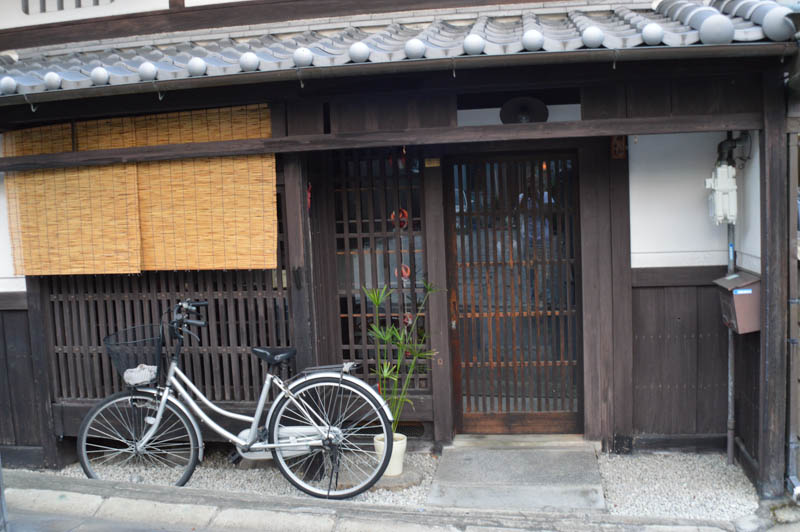
Gangō-ji Temple was moved to Nara in 718 and the temples grounds occupied a large area. Most of these structures disappeared and gradually the locals established their home on these grounds, which is today’s Naramachi district. Parts of Gangō- ji Temple still remain. Many of the buildings built by merchants were in the “machiya” style – long and narrow townhouses with tiled roofs. A mix of wood and stone were used. White plaster walls with wooden lattice windows mingle with dark wooded walls and interiors. Over time, many of these traditional “machiya” architecture style homes of the former merchant district had been converted into tourist and artesian shops, accommodations, cafes, restaurants and museums. However, the old world charm of Naramachi which had been wonderfully restored, retained and lived. A living museum indeed!

Within the beauty of green (tiled roofs) and
vermillion (pillars),
The imperial city of Nara is now in its glory,
Like the brillance of flowers in full bloom.
– Ono-no-Oyu, Man’yōshū(circa 759AD)

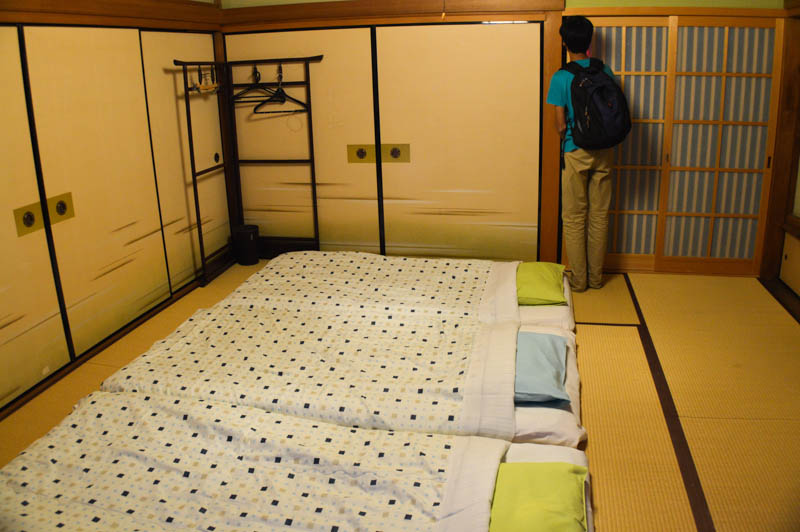
Nara is our last stop and we decided to stay in a nice Japanese style home. Our accommodation was Sakuraya Guesthouse in the heart of Naramachi. Kayoko met us at the door and I immediately had a liking to her. We were immediately invited to some tea in the dining hall which faced a lovely inner – courtyard garden, “tsubo-niwa”. Later we were led upstairs to our Japanese style tatami mat floor and sliding door room. It was called the ‘Kaze’, Wind, room. From an adjoining screened balcony, we could see the garden. Futon beds were already laid out. Downstairs, we had another round of tea and some lovely biscuits. We did not feel like we were staying in an accommodation but at a friend’s place. What a place! It felt like a ryokan than a guesthouse as the name suggests. Kayoko was like a long lost friend. It was a good feeling.

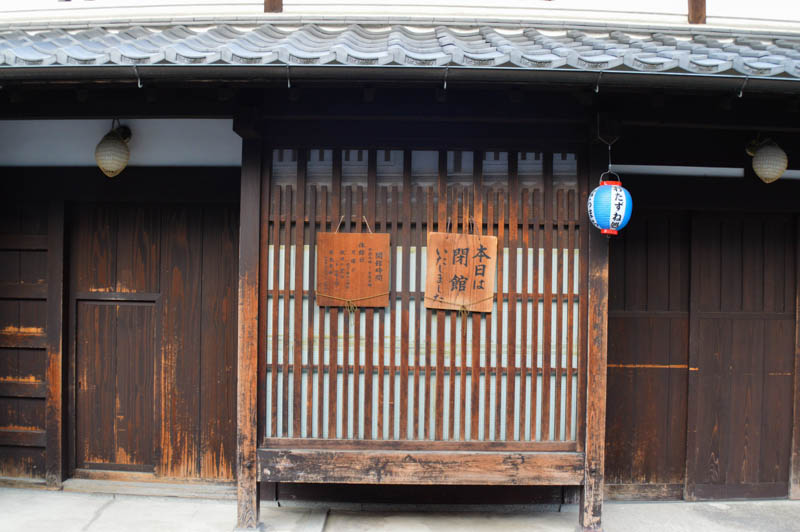
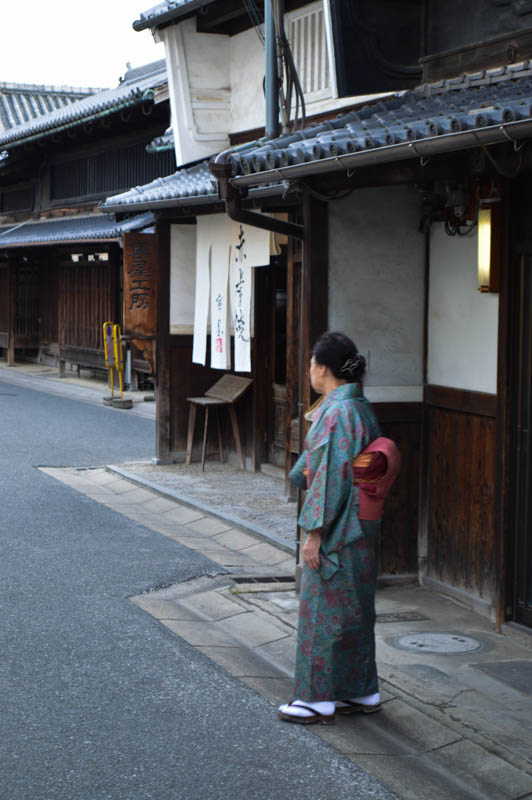
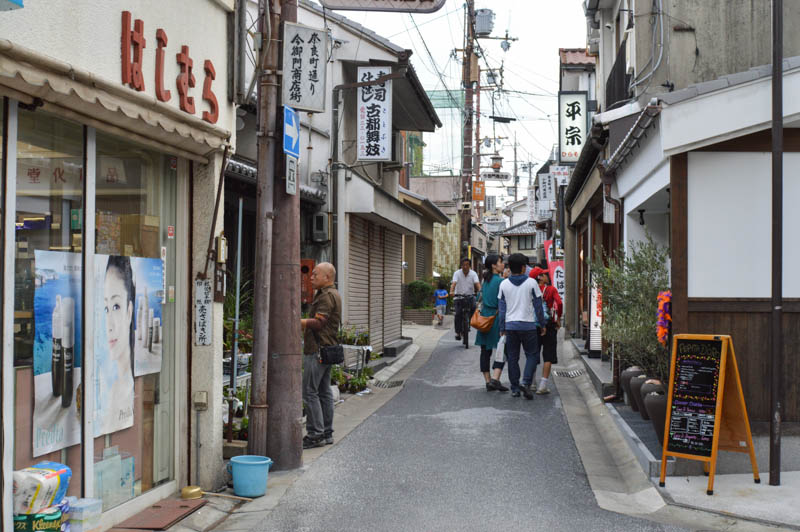
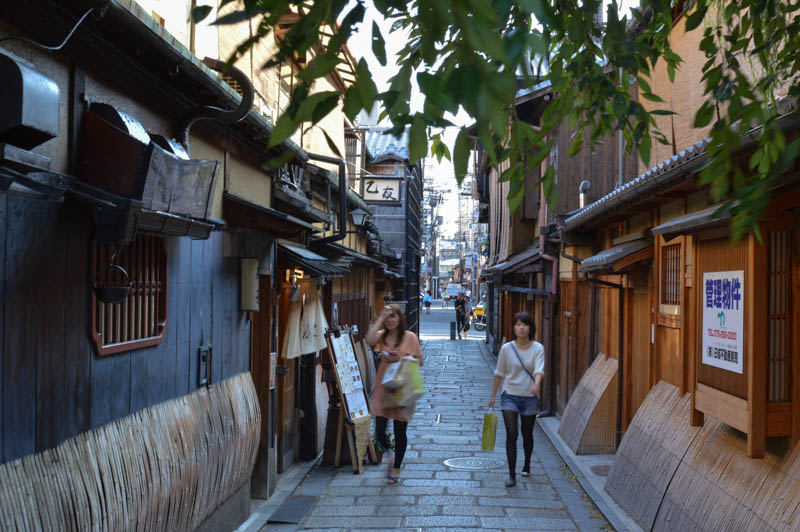
We wandered the narrow streets of Naramachi. Besides the lovely restored wooden homes with tiled roofs, one common sight is the overhead electrical wires. As we walked, I noticed that there were hardly any people around. Doors closed, “noren”, curtains, flowing in the light breeze and hardly any sound. An elderly lady dressed in a lovely colourful kimono appeared from her home and disappeared into an alley. The streets branch off into complicated alleyways. We were unsure of where we were going but it did not matter. Getting lost here is a good thing. We came across gift shops and small eateries. The more we walked in this laid back old town, the atmosphere of the 19th century oozed out. A lady dressed in kimono, emerged out of her shop and poured a bucketful of water onto the street. Then she swept the street of dust and re- entered the shop.

Kyoto

untitled-228Kyōto City with a population of over 1.5 million seemed uncrowded. It was the imperial capital of Japan for over a thousand years. It is sometimes referred to as the City of Ten Thousand Shrines. You will know why as soon as you arrive in this bustling city. Our first introduction to the city was via the “shinkansen” into the ultra-modern and stylish, Kyōto-eki, Kyōto Station. This towering building was packed with commuters, diners, shoppers and everyone in- between. Besides being a train station, it also has several floors of restaurants, department stores and shopping malls. On the roof top, the whole of Kyōto is on display. Ours was not as the weather was hazy.

Walking within downtown Kyōto, tiers of pagodas sprout from the glass, concrete and steel surfaces of the urban sprawl. Kyōto Tower raises high into the sky. After dark, the brightly coloured Kyōto Tower is reflected off the glassy surface of the station building.

The local buses, conveniently located at the train station, provided transport to all the major sight-seeing places. A 500¥ two-day pass offered convenience and takes the hassle of payment of fares. Bus drivers are polite, although speak little English, and very helpful. Patience with foreigner’s enquiries is remarkable. At every stop, the driver thanked each and every passenger. No one is rushed or pushed. This is exemplary of the Japanese people.

untitled-229 untitled-230 untitled-233 untitled-232

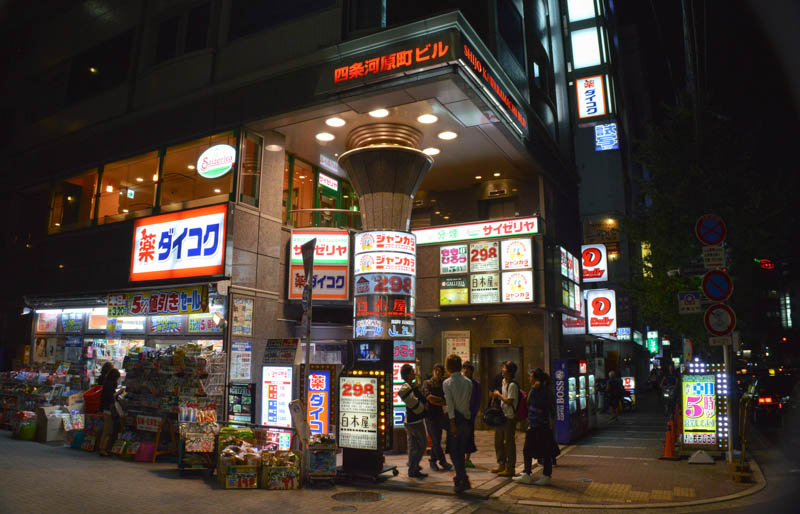
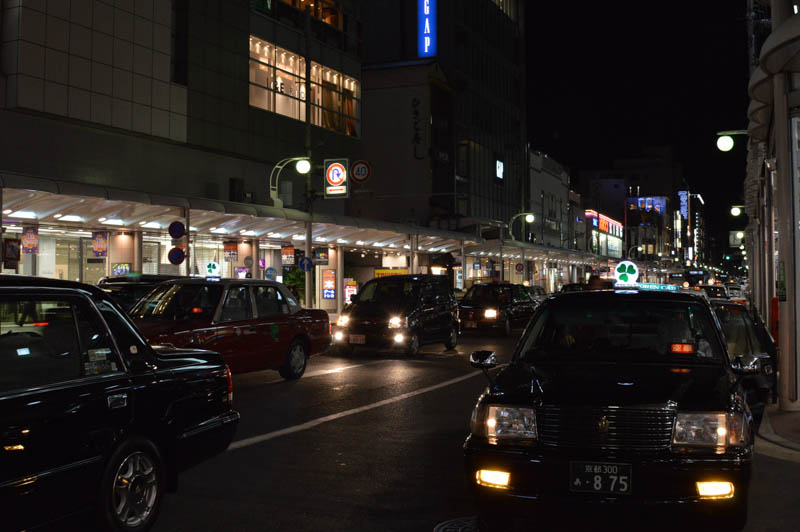
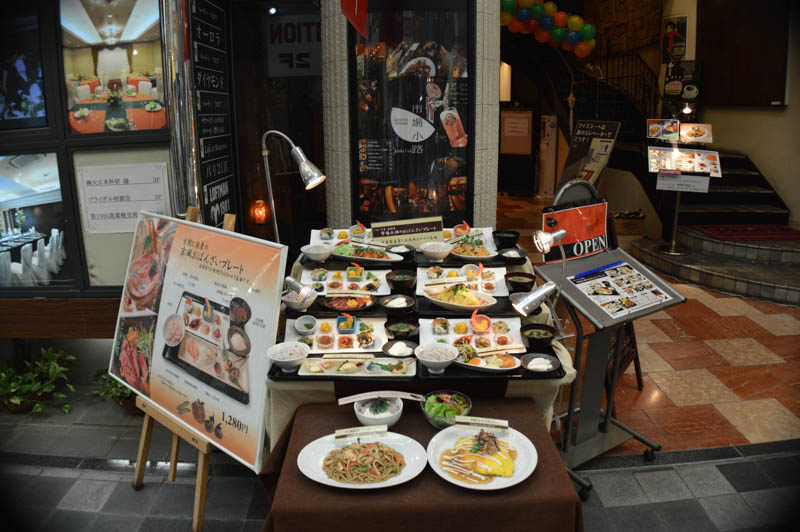
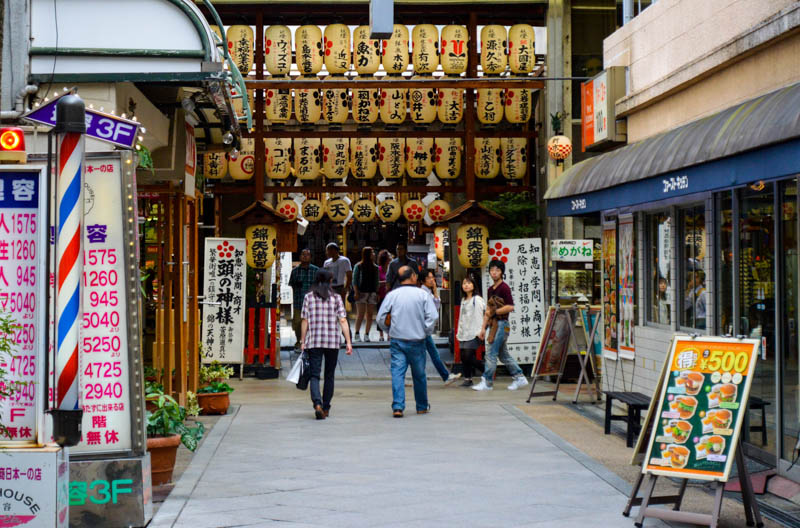
By day, we were busy travelling between the numerous sights – temples, restaurants and nearby streets. However, at night, with a much slower pace, the brightly lit neon lights come alive. Street food vendors set up stalls under narrow alleyway, signage and plastic display of dishes sprout at doorways and bright lanterns attract commuters to stop and refuel.

untitled-270

untitled-269

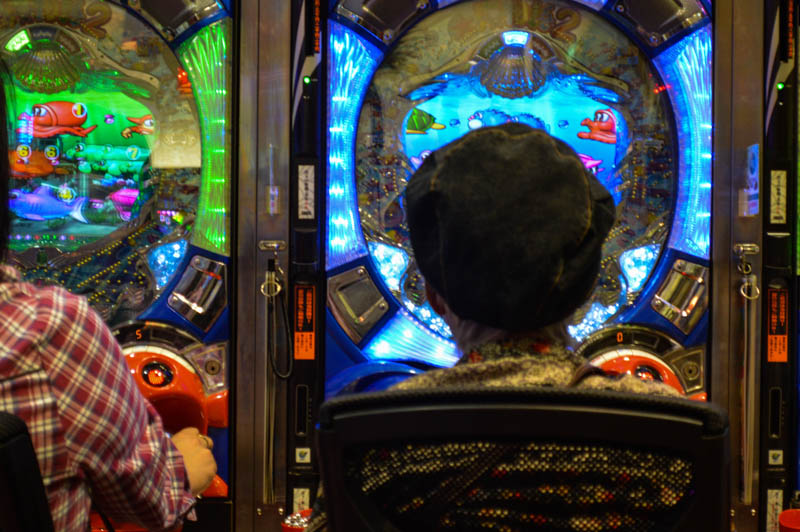
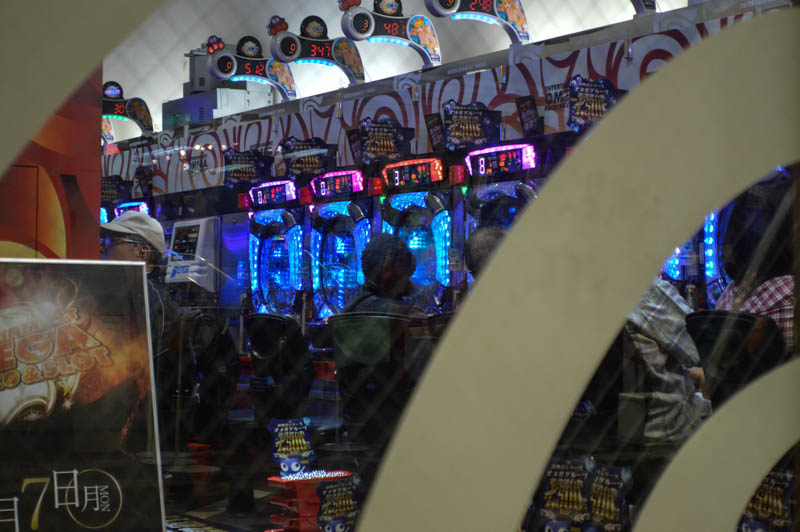
Loud pounding noises emerged from certain brightly lit premises. This is a national obsession and a gambling game – Pachinko. It is like a pin ball game but uses large quantities of rounded metal balls. It is dizzying, loud and smoky. These parlours can be found throughout Japan. The Japanese Pachinko industry is bigger than the Japanese auto industry. Yearly revenue is around ¥29 trillion (US$378 billion) a year. One in four Japanese spend an average of US$7000 annually!

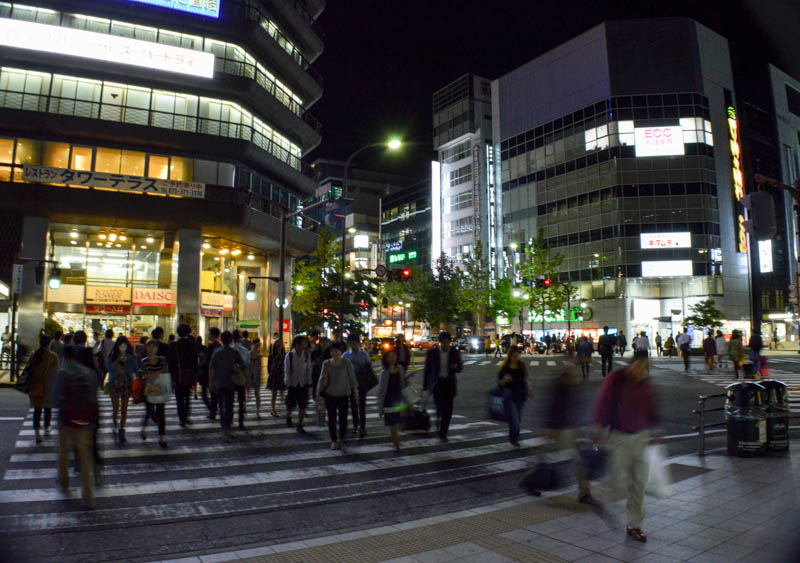
A major shopping area along Shijo Street is centred on the intersection of Shijo and Kawaramachi streets. Bright lights from department stores offer branded goods. For arts and crafts, it is best to go off streets like Nishiki Markets and around Higasiyama area. Other major areas include the mega – Tokyo Station with its departmental stores and the two narrow Teramachi and Shin-Kyogoku Shopping Arcades adjacent to Nishiki Market. Little shops are dotted around the major tourist spots dealing in gifts and souvenirs.

untitled-268

untitled-236

untitled-237 untitled-227

Although Kyōto is today a vibrant, crowded and modern city, the old and historic parts of the city provided a sense of serenity and transported to another world. The mixture of these cultural treasures, traditional and modern architecture, exquisite cuisine and history, all mingle seamlessly to form a unique environment.

The old ways are retained and lived every day. The numerous temples and shrines with their beautifully manicured gardens change with the seasons. Kyōto seems to be successful in retaining its past. The traditional way of life, dresses, the kimono, and the old shops houses, “machiya”, still functions in the city’s daily life. The conveniences of commuting around the city surrounded by mountains make it, not only a convenient place to travel, but a delightful one too. This is why we were so intrigued by this delightful and enigmatic city. I was not disappointed and my memories, through school books, of this old capital remained intact.

Kyoto – Pontochō

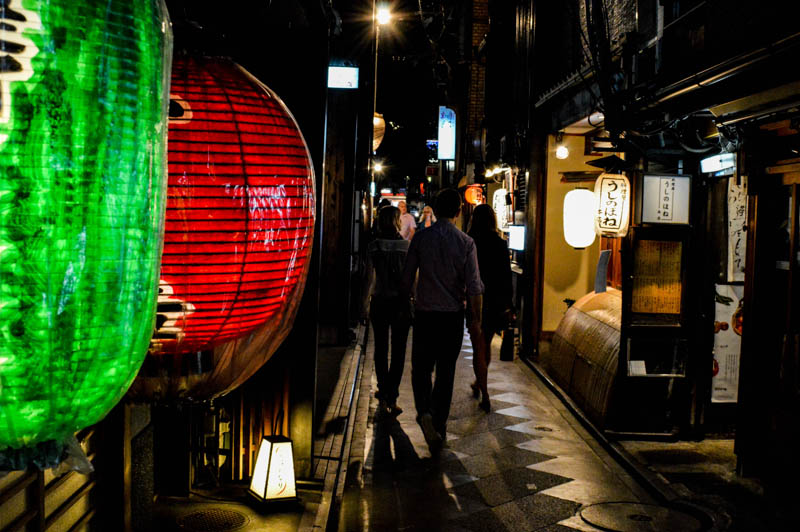
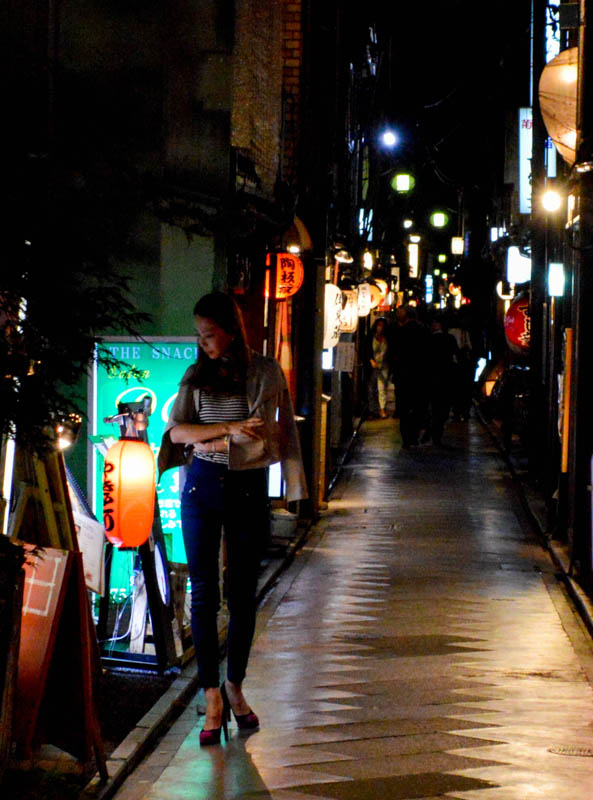
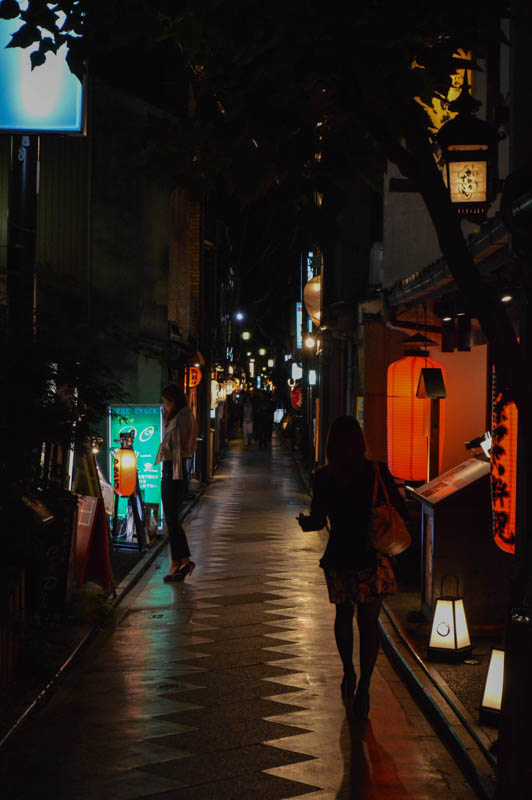
untitled-218It was early evening and dusk had set in. We headed to a popular Kyōto entertainment area, Pontochō, located in an atmospheric area between Shijo- dori and Sanjo-dori, west of Kamogawa River. Off the main road, we entered an inconspicuous narrow alleyway with a few lanterns hung on an overhead signpost. Upon entering, a different world seems to exist here. This pedestrian only street of well- preserved traditional 16th century dark wooden houses is packed with restaurants offering inexpensive yakitori to modern and traditional cuisine. Western- style restaurants and pubs are conveniently located here as well. On the flip side, there are the expensive geisha houses and “Chaya”, tea houses. Pontochō is located in Kyōto’s “Hanamachi”, geisha district. Working geisha and “maiko” can be seen in this area. Many Kyōto residents and visitors suggest this to be the most beautiful street in the city. I may have to agree.

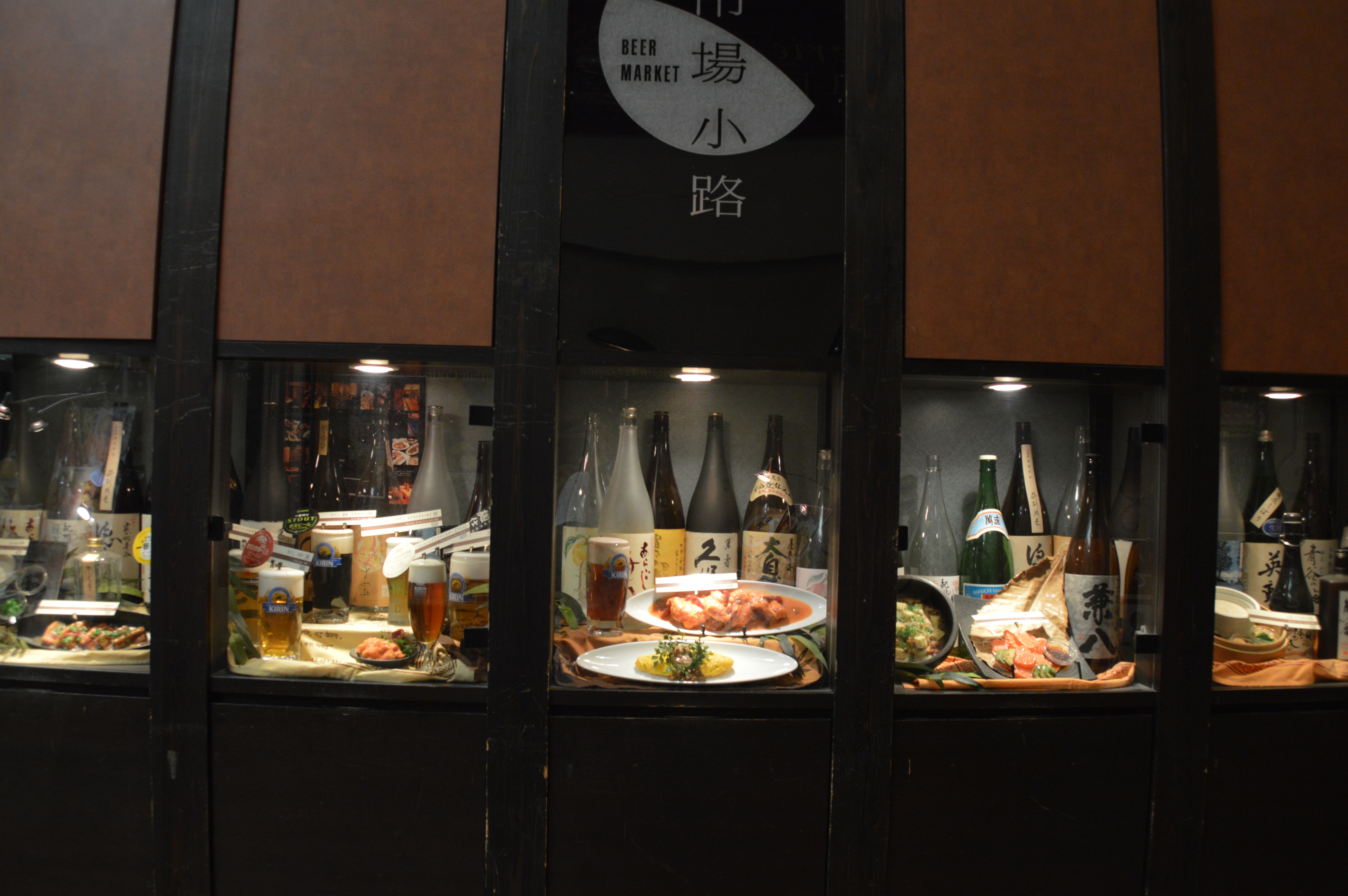
untitled-224 untitled-222 untitled-216 untitled-212 untitled-211With soft light from road side lanterns and dimly lit street lights, this street oozed charm and a feeling of stepping back in time of the Edo Period. Although narrow and crowded, the paved street was pleasant enough to stroll. With numerous choices of eateries, we were careful to read the menu, some in English, and check out the prices before venturing inside. High end tea houses entertained by geisha are also intermingled here. Samples of dishes in plastic and interestingly displays of fresh vegetable were laid at the entrances. Sake bottles lay at the doors to entice and welcome visitors. Everything is neat, tidy and certainly inviting.

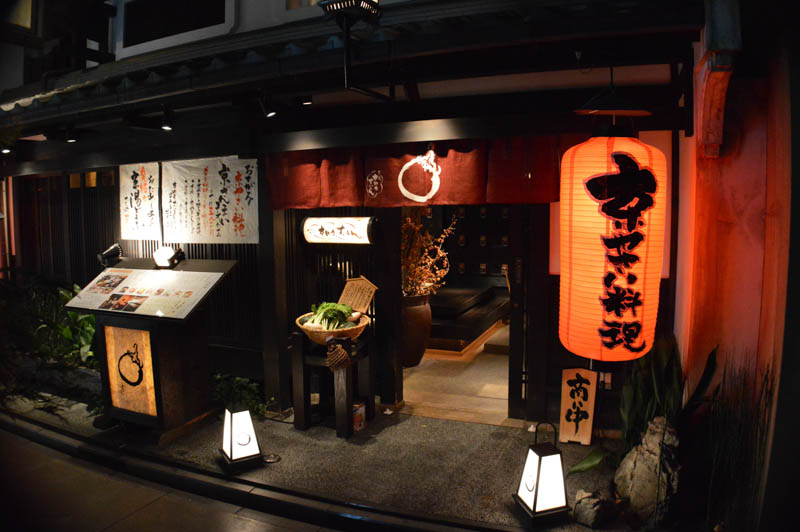
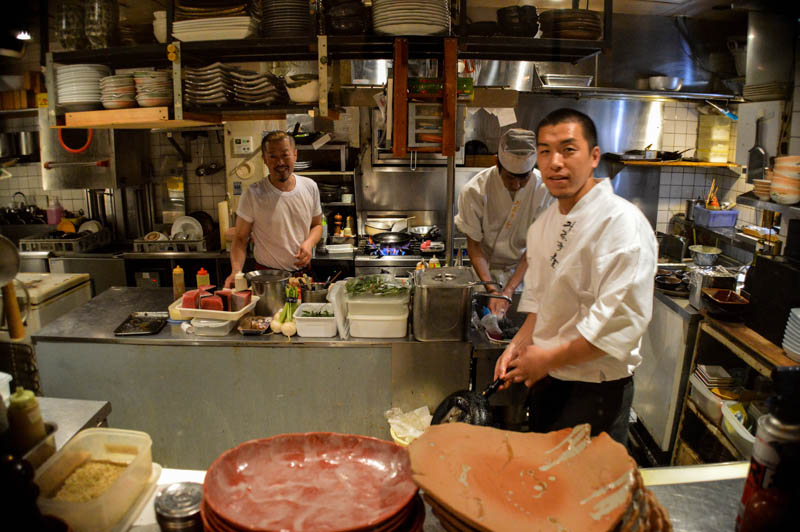
We choose Mimasuya Restaurant located in a restored old merchant house. With the usual loud mass gesture of “irasshaimase”, welcome, from the kitchen staff, we were ushered into a cosy room over- looking the Kamogawa River. City lights twinkled across the river. The staff spoke little English. The dishes, however, were beautifully presented and were delicious as all our meals had been so far.

We had “sushi”, tuna “sashimi” platter, salmon and tempura platter accompanied with the usual “tsukemono”, pickled vegetables and miso soup. The ambiance and setting of the interior together with a polite and friendly service, it was indeed a dinner to remember. I looked forward to saying “sumimasen, okanjo o kudasai”, excuse me, the bill please. The response is received with delight. The bill tonight was ¥8000. As we walked past the open kitchen to the exit door, again, en-mass, the kitchen staff thanked us. We felt welcomed and appreciated. It was a good feeling.

untitled-225 untitled-201 DSC_0512We continued our stroll down the wonderful street. Little streets branched off leading to various establishments including karaoke and bars. We entered a main street with a canal lined with weeping willows. Soon, we were back in the din of Kyōto City. Pontochō is essentially a must see sight in Kyōto both for ambiance, old world charm and delicious food. This is our last night in Kyōto before we head to the first ancient capital of Feudal Japan, Nara. Today, unfortunately, there was no encounter with the beautiful geisha.

Kyoto – Nishiki Market

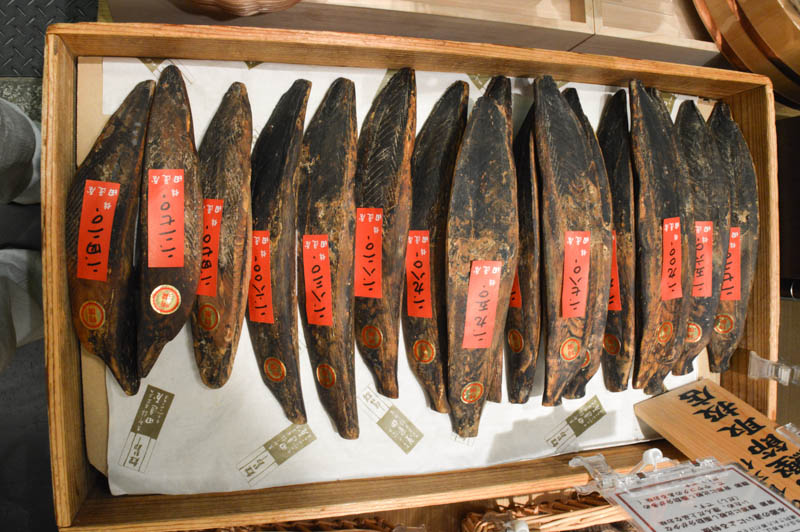
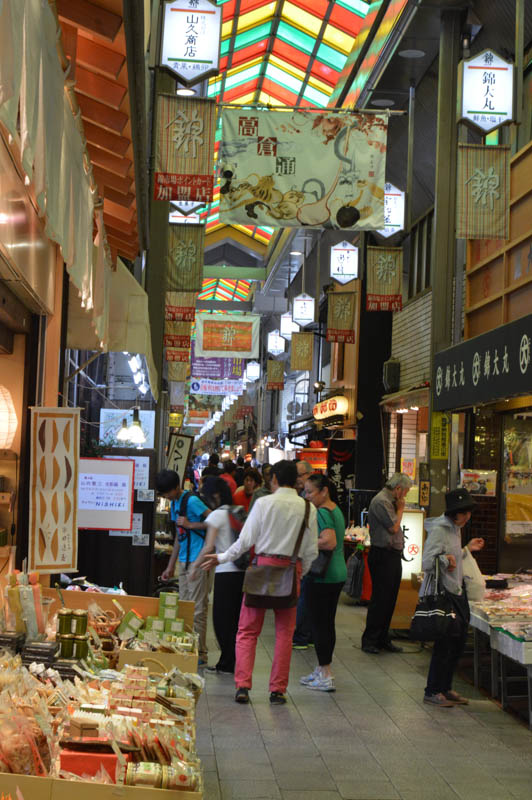
untitled-261Located near Shijo Avenue and Kawaramachi Station is the popular “Nishiki Ichiba”, Nishiki Market. It was originally a wholesale fish market in the 1300. Over time, the wholesale market evolved into a retail market. Today, known as ” Kyōto ‘s Kitchen”, this lively market specializes in a variety of items, particularly food, including delicious mocha of all kinds and styles; fresh vegetables stalls; fresh seafood – fish, squid, scallop; fried tempura – seafood and veg; solid “hanakatsuo”, shaved fish; “wagashi”, Japanese sweets; “yaki senbei”, grilled crackers; dried seaweed,” kombu shinise” and many more. This is a great place to find Kyōto specialties and seasonal foods as most of the products and produce are sourced locally, a fascinating display of artisan produce.

untitled-258 untitled-244 untitled-247 untitled-257 untitled-264 untitled-241 untitled-253 untitled-255

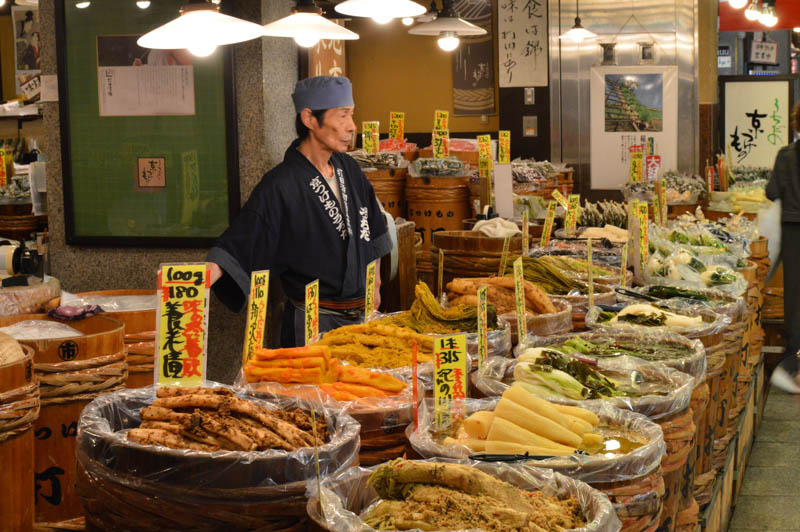
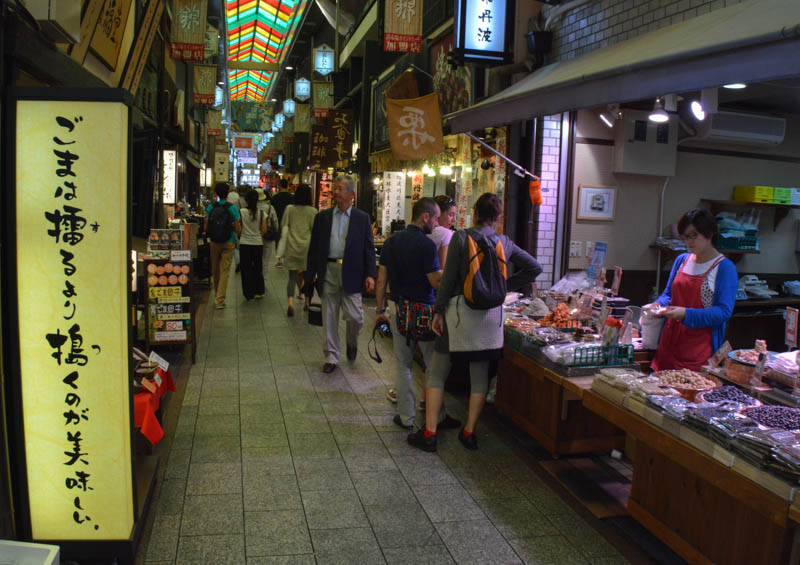
There are over hundred vendors along a narrow covered lane just 400m long. Some shops seemed to be less than two meters wide. The aroma and mixed smells floated through the air – sweet, pungent and mouth- watering. There were a few eateries with a few seating. Our first stop was a fast food like restaurant – a café. The morning crowd was lively and business was brisk. We walked down the crowded path looking at products that were unknown to us. Small samples of food were distributed to entice shopper into their stores to explore the variety of culinary delights of Kyōto. Steam rose from a tiny fried tofu shop. Time to indulge again! Stuffed vegetables with fish paste, fried prawns and noodles in a clear soup with a rather large wooden spoon. It was light and tasted wonderful. Navindd and I had inkling towards the pickled vegetables and there were abound here. However, most stalls sold in bulk. Pickled and fermented vegetable, “tsukemono” – were displayed in large wooden barrels fermented in rice bran, “nukazuke” – radish, daikon, aubergine, cucumber, cabbage, turnip, etc.

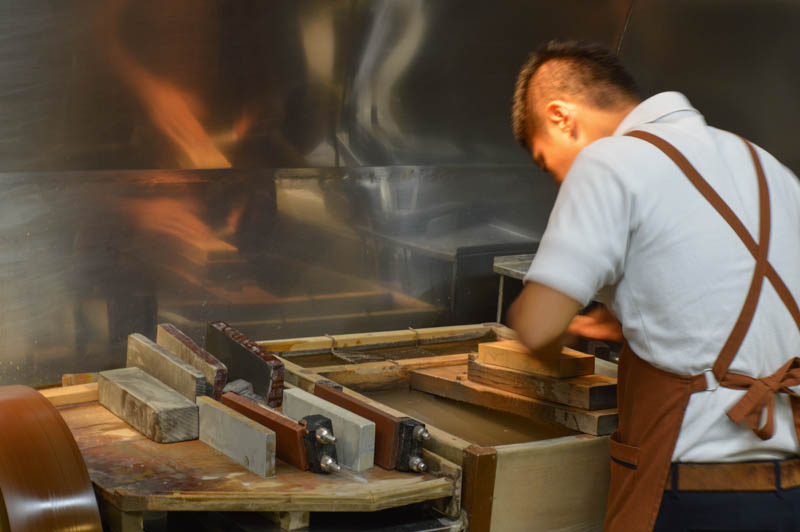
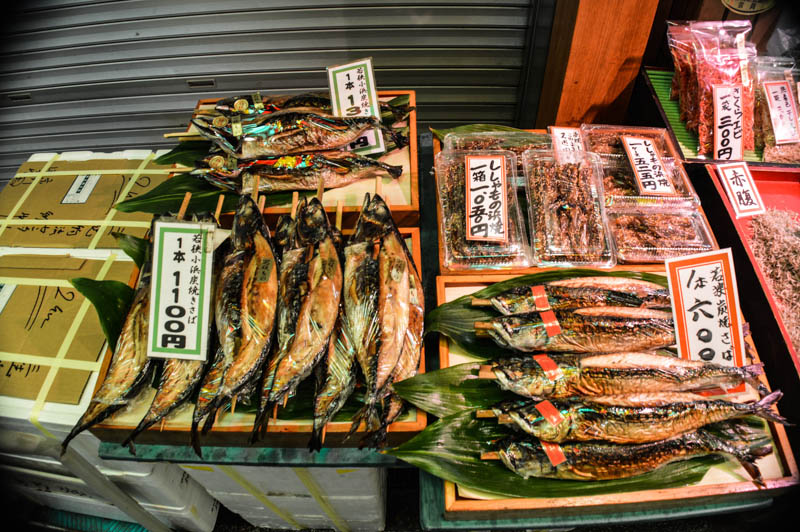
The origin as a seafood market had not vanished. Seafood, fresh and dried, of all kinds – fish, scallops, octopus, squid, bonito, etc., glistened under artificial light. At one stall, little petite “mochi” were stacked to the brim. We had to get some. There were several types and a myriad of fillings. Lanterns, red and white, hung at the entrances of some retailers gave a traditional atmosphere. I went looking for a knife shop that was popular here in Kyōto, Aritsugu. This business had existed since 1560. They were originally producers of swords for the Imperial House of Japan. Now, they produce hand crafted knifes and cooking utensils. I bought a “santoku”, a chef’s knife. I was pleasantly surprised when they offered to engrave my name on it. Not only for practical use but also as a memento of our Japan journey. The grinding machinist was busy in the background. We had tried “matcha” and “ocha” tea throughout our journey. We chanced upon one here. The smell of roasted leaves was distinct. This would be a great as gifts too. As we were exiting the wonderful pathway, we caught the sight of blowfish, “Fugu” hung from the ceiling. This fish is poisonous but in a skillful chef’s hand, it can be a delicacy. Besides food; items such as traditional ceramic ware, trinkets and stuffed toys, folding fans, traditional Japanese foot wear, a variety of textiles and kimono are available here. At the arcade, I bought a “jinbei”, a Japanese summer wear. Nishiki Market had a pleasant, vibrant but relaxed atmosphere. It is an extraordinary kaleidoscope of Kyōto culture.

untitled-252

Kyoto – Fushimi Inari Taisha

After a long walking day in Higashiyama Northern and Central regions including the iconic Gion District, we were all a little drained of energy. There are over a thousand temples and shrines distributed around Kyōto and it would be wise to select a few for a dedicated visit. We choose based on each’s unique character – dry garden, Zen tea garden, visual impact and distance. All these are based on literature available prior to travel. Nothing is definite and certain; however, there was a plan! Navindd and Lee Cheng retired to our hostel before dinner. With barely any daylight hours left, I headed to Southern Kyōto, to visit, Fushimi Inari Taisha.

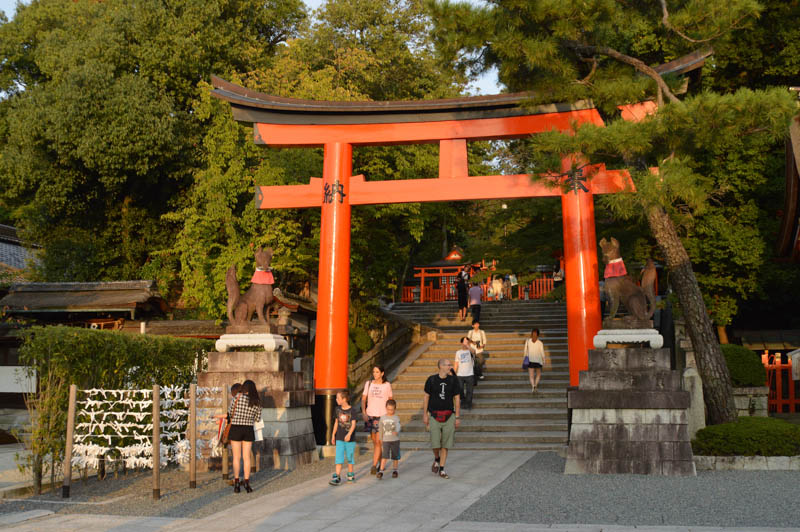
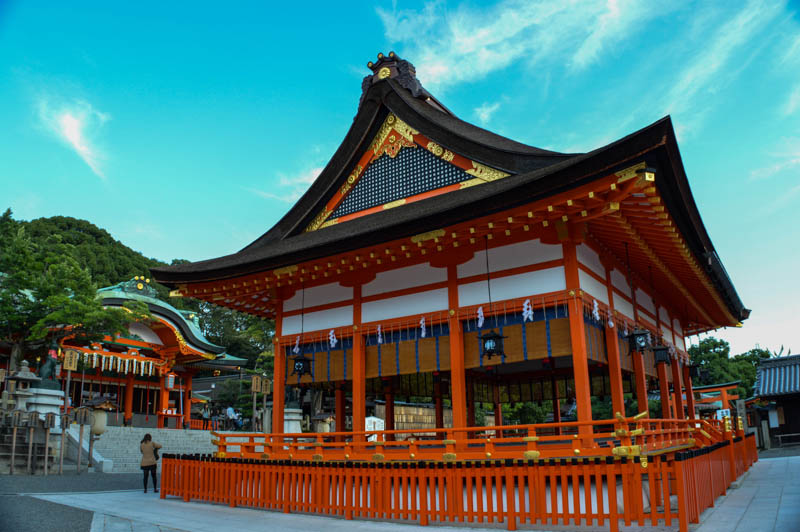
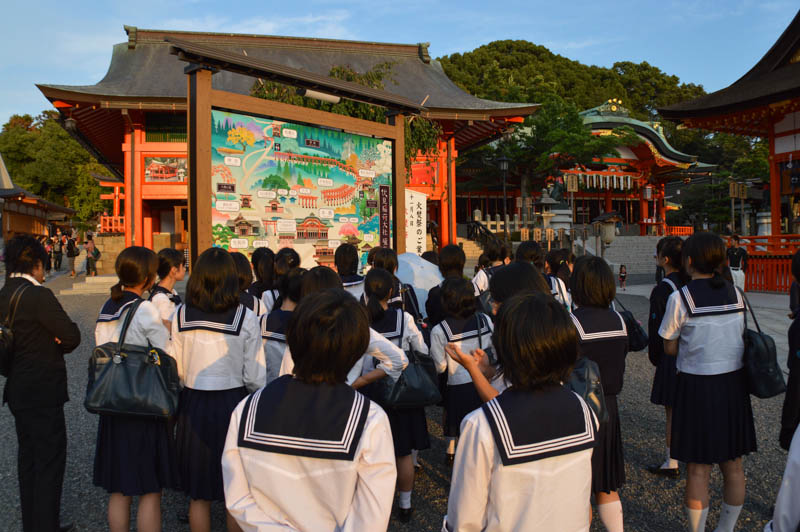
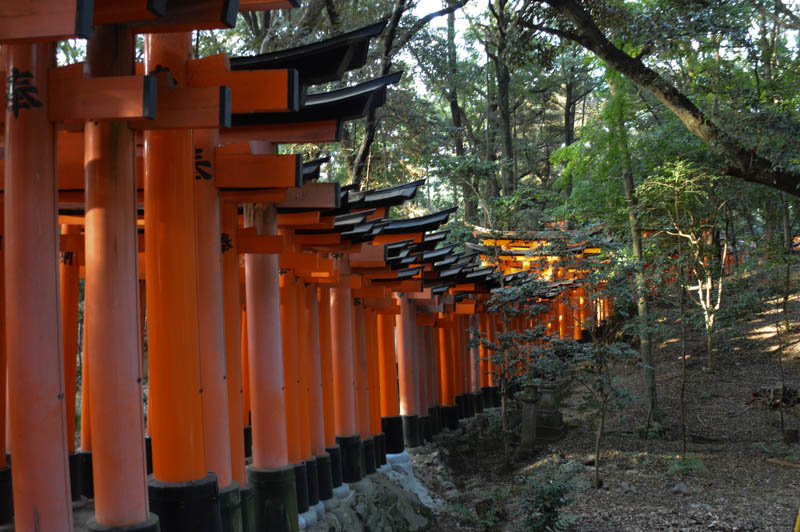
untitled-198This Shinto Shrine, dedicated to the God of Rice,”Inari”, had graced the covers of glossy travel magazines and brochures as an iconic destination in Japan. I arrived here in Fushimi town by JR train. The temple is conveniently located just across the station. The slanted setting sun shined on the giant orange “torii” gates at the entrance. Near a sign post, school girls in navy blue skirts and sailor’s cape with white top read the temple layout map attentively. Beyond this, was the tower gate, “rōmon” and the front view of the “Haiden”, Hall of Worship.

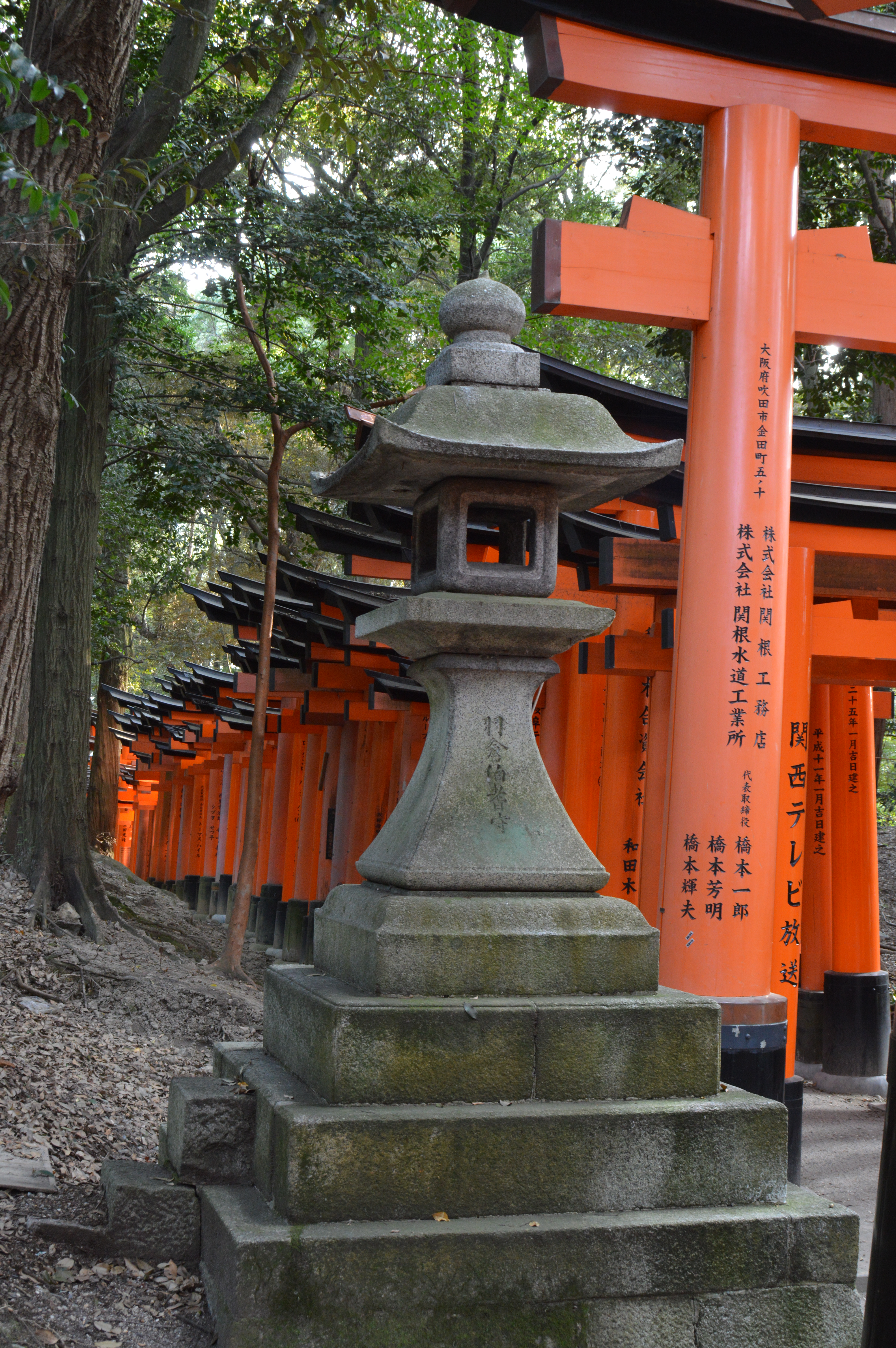
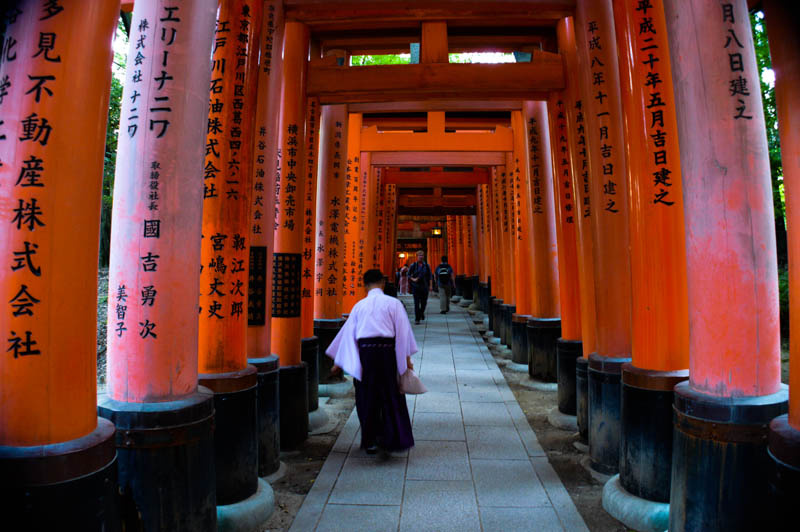
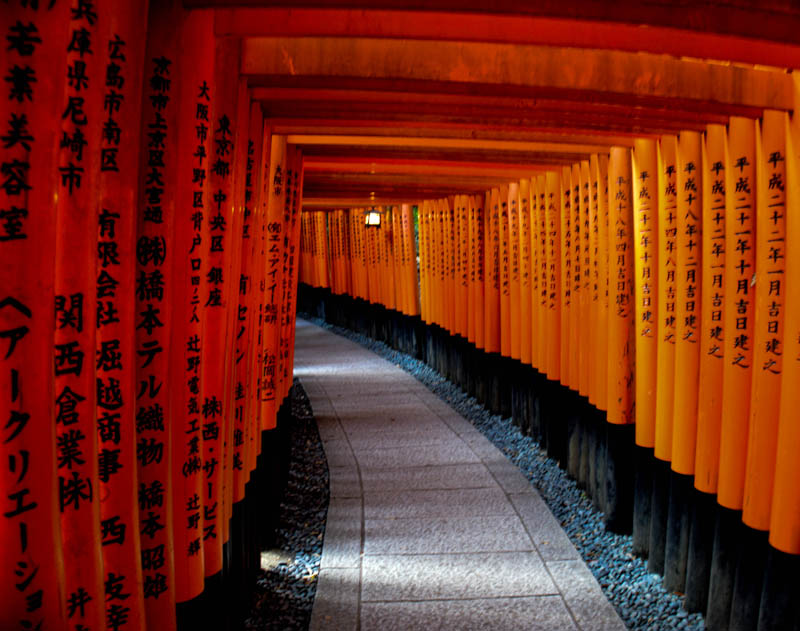
untitled-187 untitled-188 untitled-199This temple was founded in year 711 by HATA-no-Iroko (or, Irogu). There was a small but enthusiastic crowd. The sun was almost touching the western horizon. I hurried up DSC_0409concrete steps past stone statues of foxes, “kitsune”. They are regarded as messengers. It was peculiar, keys, apparently of the rice granary, were kept in their mouth. As I climbed up the hill, I encountered tall stone “torii” entrances. Eventually, I ended in an open intersection with two parallel rows of smaller wooden “torii” tunnels called “Senbon Torii”, Thousands of Torii Gates. The trails lead into the wooded forest of the sacred Mount Inari. The pathway is laid with a concrete pathway with grey pebbles on either side. The orange – vermillion lacquered “torii” gates were lined up closely that it created a tunnel like effect.

There was hardly anyone around and walking alone with only narrow shafts of light piercing through the wooded forest was quite eerie. I looked into the forest slopes. The bright red-orange “torii” straddled up the mountain. Stone lanterns and little shrines were scattered around. These “torii” gate had been donated by individuals and business. The larger the donation, the bigger the size of “torii” gate and higher up the mountain. Perhaps to bring good fortune, a harvest! Names of these donors are inscribed at the back of each “torii”. At intersections, hundreds of miniature red “torii” gate were place at the shrines. This is perhaps for those with a very modest budget. The passage uphill looked like eternity.

DSC_0396 The sun’s shafts of light brightened parts of the tunnel leaving the rest darkened. The effect was stunning. Small lanterns hung inside the tunnel intermittently. Stone slab pathway gave way to steps which ascended higher. The “torri” gates were now taller and bigger. Dusk had set in and the tree canopy inhibited the remaining daylight. I decided to retrace my steps back to the entrance. The 4 km trail takes about 2 – 3 hours with over 5000 vibrant red-orange “torii” gates from the base of “Inari-san”, Mt Inari. It was quite exciting and unique experience walking through this ‘tunnel’. These thousands of lacquered gates is one of the most iconic landmarks of Kyōto and a quintessential image of Japan.

untitled-195 untitled-191

The ever-changing colours on the lacquered “torii”, created by the blazing setting sun, were amazing. Within meters outside the ‘tunnel’, dusk had set in the rather dark, eerie and silent mountain forest. It was a captivating phenomenon.

untitled-192

Kyoto – Shinbashi Dori and Gion, Higashiyama District

untitled-175

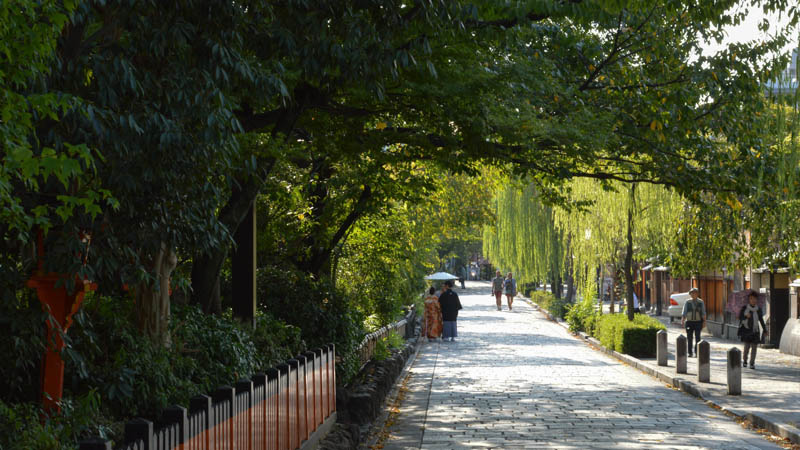
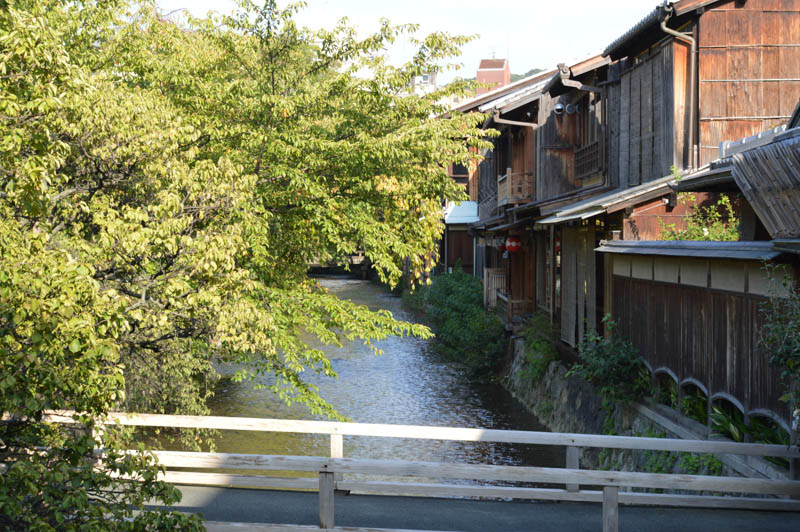
After a Zen experience at Shoren-in Temple, we returned to the reality of this bustling and lively city at Higashi-oji Dori, the main road at Higashiyama. We stopped at a lovely desert shop to refuel. We walked along a quieter Shinbashi Dori. Within minutes, we seemed to a million miles away from the frantic cityscape as we crossed the Tatsumi Bridge near a row of dark orange hued railings. A small shrine, in the north, with a vermillion gate temple, marked the beginning of this street. This is Shinbash Minami-dōri, a lovely cobbled street densely planted with cherry and weeping willow trees along a canal, “Shirikawa”, White River. This is a very picturesque street, particularly the south bank, with trees overhanging over the river and connected by narrow bridges. Suddenly, we seem to have entered into another world. On either side of the street, rustic double storey merchant houses, mostly converted into high end restaurants, tea houses, “ochaya” and probably a few homesteads. Behind wooden lattice windows, slatted doors and bamboo screens “oisudare”, high paying guests are probably entertained by Geishas’ in the evening. Flowing “noren”, cloths hung above the entrances, identified each establishment. During the cherry blossom season, this street is packed with people. This area is the most scenic and quieter part of Gion. We loved it as it was a reprieve from the heated fumes and bustling traffic.

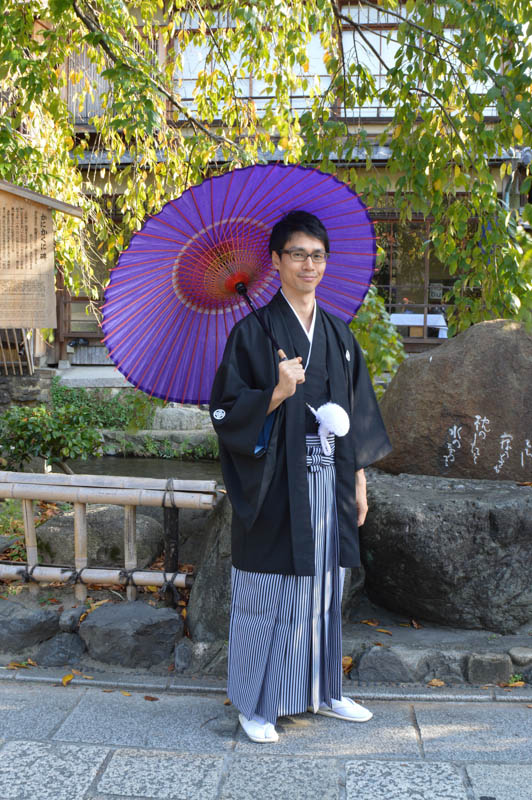
untitled-183 untitled-181 untitled-180 untitled-178Close to the Tatsumi Bridge, a lovely and traditionally dressed couple, who had just married, were having their pictures taken against the leafy and atmospheric street. The bride wore a beautiful and colourful kimono. Both the couple had his and hers umbrella. With a little smile and “sumimasen”, they allowed me to photograph them. I should have done the same with my opportunity when I encountered the “geiko” and “maiko” in Arashiyama! Through a narrow bridge, we continued our walk towards the heart of old Kyōto in Gion, Hanami- kōji, Flower Town.

Gion, Higashiyama District

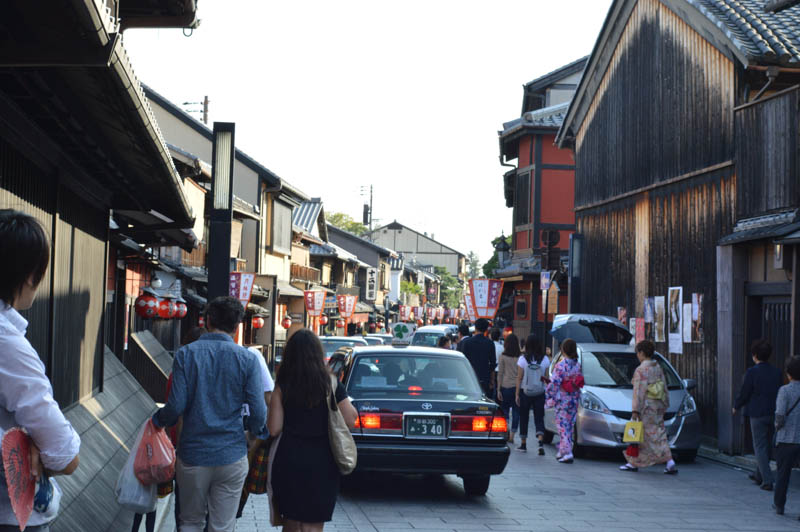
untitled-185This is the most popular area in Gion, Hanami-kōji, located between the busy Shijō- dōri and Kenninji Temple. The main street and the side alleys were lined with rustic double storey “Machiya”, town houses which had mainly been converted into restaurants, shops and tea houses. Red lanterns hung at the entrances all along the street. It was lunch time and we wandered on the street looking at the prices quoted at the entrances. This is an exclusive and therefore expensive area for meals. In the evenings’, behind screens and doors, high paying clients wine and dine with the company of the magnificent geishas’ and “maikos”, a “geiko” apprentice. Possibly served the Kyōto style Kaiseki Ryori (elegant Japanese cuisine). This is one of the licensed geisha areas, “hanamachi”. Tourist will never be entertained by a geisha unless they have an introduction and an invitation to a tea house, “ochaya”. Fortunately, there are other avenues to witness Geisha perform. Today, this paved street was crowded the people and traffic. Watching kimono clad women walking daintily along the street was a delightful sight in the late afternoon heat. This is a good place to watch lavishly dressed and beautifully poised geisha make their way to an evening engagement. We headed towards Yasaka Shrine where we finally indulged in some “ramen”, noodles.

Kyoto – Shōren-in Temple 2

untitled-165

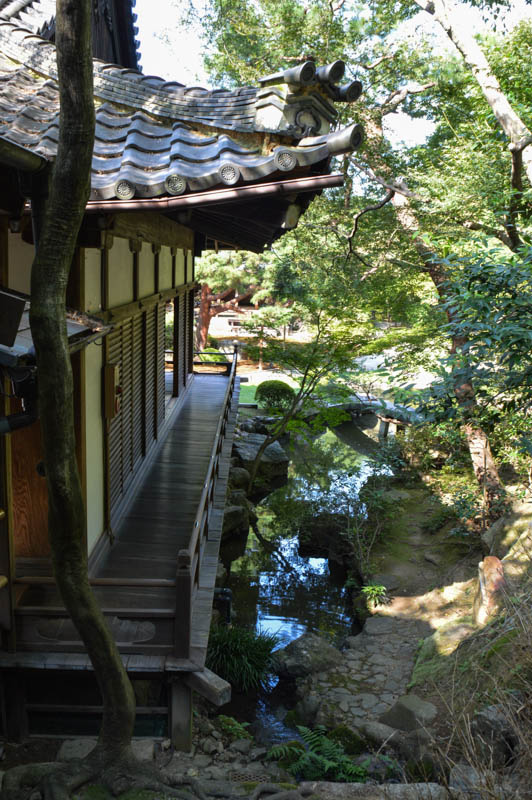
We dragged ourselves out of this relaxing Kacho-den Hall to the next building, Kagosho, connected by narrow wooden walkways.  It has a few tatami-matted rooms separated by “fusuma”, sliding doors. At one end of this hall is a typical image; a framed view of a low branching either a maple or cherry with young shoots emerging. The contrast of the darkened interior by dark wood refracted exterior light and the lime green leaves of the tree created a delightful view. “Fusuma” walls were painted with pines and birds. The whole room was sparsely decorated with items. This is something that I liked; uncluttered, simplicity at its best. The building has a veranda on all three sides, and with a great view. I loved the idea of a veranda surrounded by nature. The “Ryujin-no Ike”, Dragon Heart’s Pond, lies just beside on one side. A little stream gently flows by. Through another narrow wooden corridor, we passed an almost rectangular raised “tsukubai”, stone water basin. This one has a name, Ichimonji Chozubachi – symbolized valiance. It is said to have been donated by Toyotomi Hideyoshi during the Momoyama Period [1573- 1603].

untitled-160

The Shidoko-do Hall houses the temple’s main objects of worship, two paintings – a Mandala (not commonly displayed) and a replica drawing of Fudo Myo-o, a fearsome deity of wisdom who is surrounded by flames and holds a sword. The view of Kogosho and the “Ryujin-no Ike”, Dragon Heart’s Pond, with the backdrop of the Higashiyama Mountains is enchanting. This picture is complete with a “tsukiyama”, artificial hill, a thirteen-story stone pagoda, pond and mindfully selected plants – combines palms, pines, shrubs, evergreens and deciduous trees, flowering plants, etc. A large stone, “Koryu-no-hashi” in the pond is supposed to remind one of the back of a dragon bathing in the pond. A stone bridge connected the two banks. On the right of the pond, is the Garden of Omori Yuhi, along the slopes. This is one of the most beautiful Japanese gardens that I had seen that effectively utilizes its surrounding natural beauty.

untitled-164Behind the pond, on the slopes is the Garden of Kirishima, planted with “Kirishima”, azaleas. A path leads towards the barely visible tea house, Kobun-tei. This is a strolling garden with paths meandering through. The next building is the Shinden. A large palanquin with the imperial chrysanthemum crest on it was displayed. Behind, on the white “fusuma” walls were painted with storks amongst pines and cherry trees. In another room is a large painting of a beech and pine tree by Sumi Yoshi. In the courtyard, there is a great view of one of the ancient camphor trees.

Shōren-in Temple had been a wonderful experience. Perhaps its original design as an imperial palace; three different but wonderfully landscaped gardens utilising the natural surrounding hills or perhaps there were few distractions, people. This is now one of my favourite places.