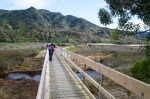
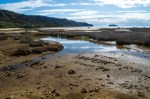
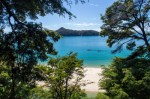
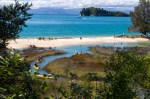
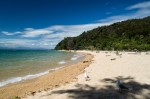
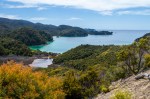
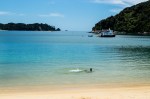
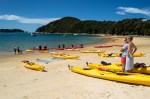
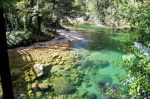
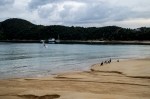
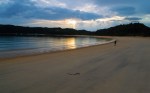
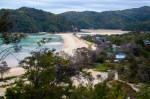
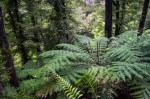
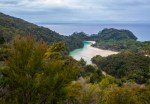
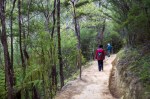
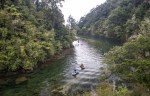
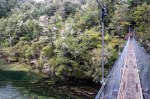
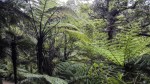
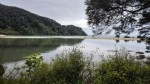
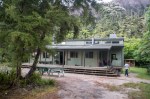
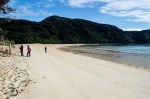
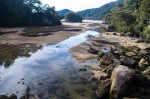
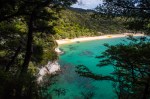
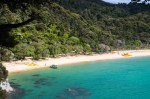
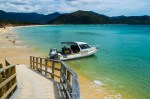
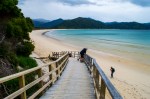
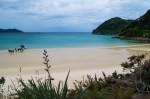
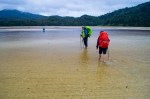
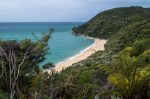
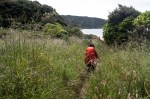
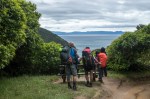
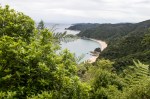
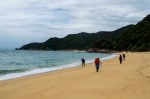
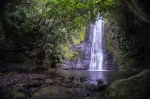
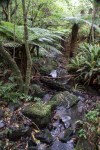
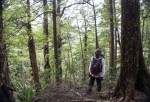
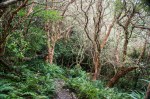
5 day hike on the Able Tasman Coastal Track in November 2018. Stared at Marahu and finished at Totaranui. Then returned to Marahu by water taxi. Beautiful lagoons, lush native forest, emerald green and turquoise water, tidal inlets, wild life, creeks and rivers and lots more.
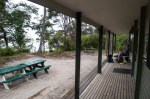
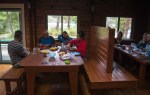
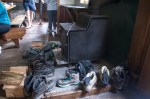
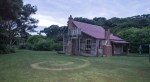
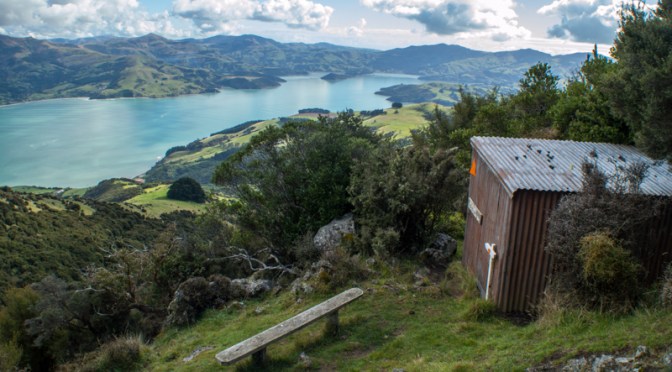
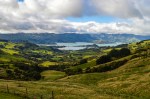
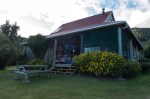
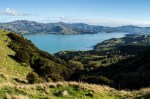
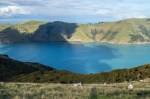
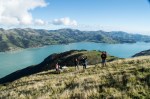
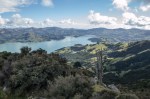
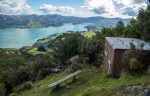
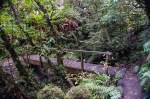
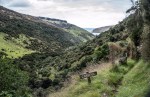
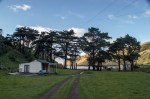
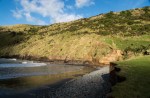
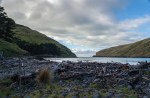
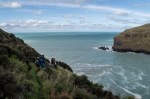
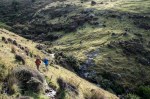
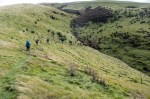
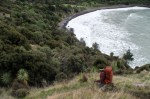
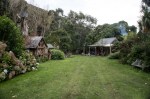
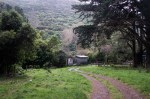
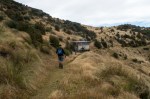
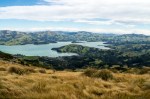
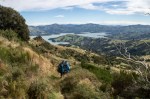
A group of us made this 29km in Akaroa Banks Peninsula 3-day trek , off Christchurch, in April 2018. This trek is on private property and permits only 12 persons a day. Porter service is available. It consists mainly farmland, spectacular cliffs and native forest (with a diverse flora) with the trek meandering mainly along the rugged coastline of the Pacific. It had all the seasons plus fierce winds and rain. Small seal colonies nest on the craggy coast. Bird life is abundant. Even caught sight of a Wood Pigeon. The elements were a challenge but rewarded with ever-changing and fantastic views. Life in the hut is basic but comfortable. Some basic food is available, on an honesty basis. Cooking and resting our weary legs in front of the fireplace was soothing. With good company, it was a wonderful trek taking in remote and isolated southern coast of NZ.
From Beijing, we headed to Pingyao Ancient City, a UNESCO listed town, in Shanxi Province by train. The comfortable ride was only marred by the sight of heavily polluted air. As we entered Shanxi Province, the darkened polluted air was clearly visible. Pingyao train station is about 8 km from the old city.
The well preserved Ancient City is enclosed within a Ming and Qing Wall, built in the 12th century. However, Pingyao has been in existence since 600 – 700 BC. Today, most of the buildings had been restored to its former grandeur. The whole walled city is paved with cobbled streets. It is a fascinating place. Unfortunately, the air is laden with thick smog resulting from burning of coal for warmth in winter. Visibility was poor.
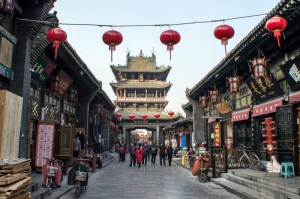
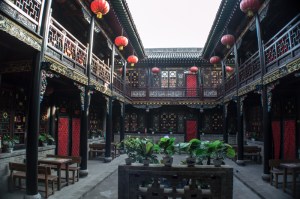
We stayed a one of the traditional 400 hundred year old courtyard mansions decorated with ornate carvings and elaborate courtyard. The best mode of travel is by walking. The main street is the busy Ming-Qing Street. There are hundreds of shops selling from food, souvenirs to accommodations. The iconic City Tower is also on this street. Street vendors fins pockets of this street to earn a living.
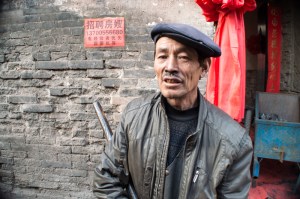
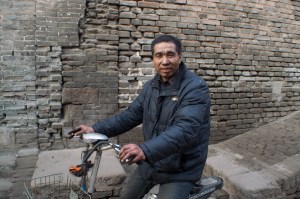
I met with workers covered in coal dust as they shovelled coal. Their hands callused from the hard work. At another site, an old dilapidated building was being refurbished and remodelled into a hotel. Work here is slow as all was done with manual labour.
There are several entrances to climb up the onto the fortified wall. Beyond it lies the modern city. Atop this wall, the view of the ancient city is revels it terracotta tiles, cobbled streets and panoramic views from the South Gate. It also provides an opportunity to pry into the daily lives of the residents. After descending from the West Gate, a narrow lane lead to a row of unrestored homes. Grasses and other plants, withered from winter, covered the roof tops.
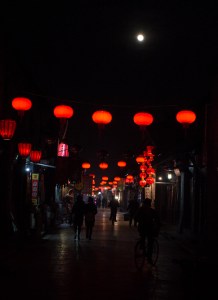
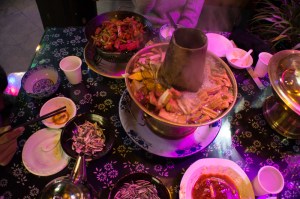
Temples, old merchant’s homes and business premises such as Rishengchang Remittance Bank or Exchange, the City God Temple and several more significant Courtyard homes dot within this walled city. The old city is a great place to wander on foot as most sights a compacted within the walls. On one back streets, I found myself tasting and wandering a vinegar factory. In the evenings, the Ming-Qing Street become lively with dinners. Red lanterns add beauty to this ancient city. Today, a full moon shone a soft glow onto the stone streets. Finally, the locals do put up some of the best Shanxi cuisines.
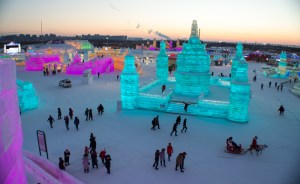
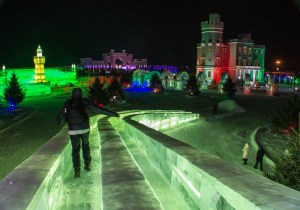
The main reason for travel to icy cold Harbin winter is to see the International Ice and Snow Festival held sometime late January till February. It is a magical place. A myriad of structures made from carved ice blocks (possibly sourced from the nearby frozen Songhua River) – from pagodas to castles and anything imaginable. For added attraction, a multitude of colored lights are fitted within the ice block to give the sculptures and structures life. These ice architecture are not only for viewing but also to be walked and sometimes slide upon. The details on some of these are truly works of art. It must be difficult to get the lights working in these freezing temperatures. There were even reindeer rides!
It is easy to get here by local bus and return afterwards. Just be aware that there are several sites offering some sort of ice show (not the international ice festival). Perhaps get the locals to help you, particularly your accommodation staff. Fortunately for us, the bus route is just off my hostel. Taxi drivers may offer to take you there but you may end up at another park and higher cost.
From dusk onward, when the lights come on, this site becomes a wonderland of fairy tales. However, the cold is very real, minus 25 and dropping! Dress appropriately, in layers. Fortunately, eateries provide much needed energy and warmth as we plodded from one sculptor to another.
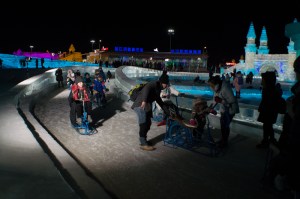
Indoor entertainment – beauty contest, singing and dancing – also make this festival atmospheric. Long queues, in the cold, for the 100m ice slide diverted me to try ice cycling. It is uniquely Chinese and a lot of fun. It is indeed a unique experience, only made in Harbin , China.
We left Beijing by train to Harbin, Hēilóngjiāng Province located in the north-eastern part of China. It is near the Russian border. It is very cold in Beijing, why go further north to even colder weather? The taxi driver told us today has been the coldest to date this year. Well, we wanted to witness the annual International Snow and Ice Festival held in January and February.
The train station are packed with throngs of people as it is nearing the Spring Festival when the whole country goes on a long holiday – the biggest movement of people for a single event. So, it is best to get there early for screening. We had already pre-purchased all our train tickets.
Once outside Beijing, the scene is rural. Surprisingly, the terrain is flat. Now, I related Leo’s stories about the Mongol’s occupation of Beijing. It was snowing in part and the landscape bleak. Navindd pointed out to coal-powered (perhaps nuclear) power station with its unique towers.
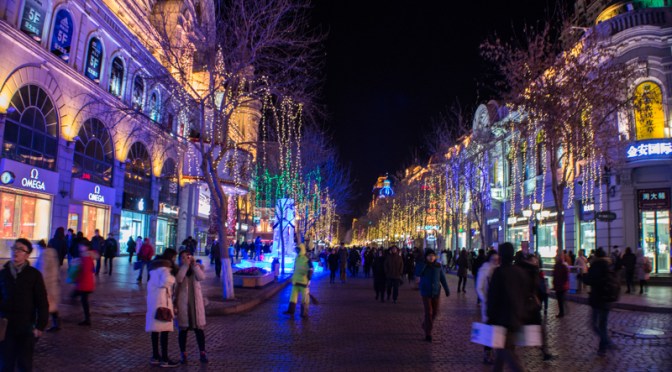
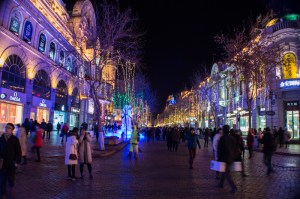
Harbin is neat and obviously very cold. Our hostel was nearby the most famous street, Central Street (Zhōngyāngdàjiē). A cobble stone pedestrian street now filled with ice and snow sculptures. At night time, they are all lit like Christmas in the park. This long street begins from the banks of the, now frozen, Songhua River. Life is moves at a slower pace than Beijing but much colder.
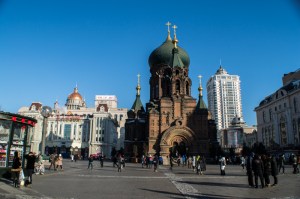
Harbin is close to the Russian border (Valdivostok). Hence, there has been a small population of Russians living earlier. The most obvious signs of Russian influence is the beautiful St. Sophia Orthodox Cathedral , now a museum, built in 1907.
The cold, below 30 degrees was bearable with the appropriate layers of clothing. However, the annoying part is, having to remove all the layers every time we entered a shopping mall, restaurant and even the public bus. It gets very hot as all these places are heated. Protect your cameras in sealed plastic bags to aclimatise
One day we decided to go to an ice park, by mistake, as we thought we were going to the Ice festival. We ended up at a park outside Harbin. To make to most, we went skiing. None of us had any experience. We suited up with the gear provided and immediately onto the ski field with a guide. The sun had already set. It was freezing. On a long down hill slope, I fell numerous times. With much difficulty, got up only to fall down on the ice again and again. However, on my second run, I was flying down the slope a a great speed. Fearing for my life, I decided to end this free sprite ride, I tumbled onto the ice to stop. After a few unceremonious tumbles, I was relieved. Now with frozen toes and finger, I fumbled into the office. I was unable to get my gear off due to the unbearable cold. However, there were some ice carvings, all light up. That was my skiing experience!
A great skiing area is Mundajiang, a town few hours out of Harbin towards the Russian border.
My accommodation was right on the corner of Dongsi West Street and pedestrian only Wangfujing Street in Dongcheng District. It is a prosperous shopping and business street. We walked on this street throughout our stay in Beijing. During the day it was filled with people – shoppers, retail workers and departmental stores including high-end brands, eateries which included Quanjude Roast Duck and the popular Snack Food Street. On arriving in the city, we headed for a delicious breakfast.
The iconic street was still filled with shoppers, workers, street artist and performers, high fashion, glimmering buildings and pedestrian only street. The glittering neon lights were blurred in this cold and polluted evening. In the middle, in the courtyard of St Joseph Church, a smartly dressed couple danced with passion. We watched for a while before the aromas of cooked food persuaded us to keep moving. Later we watched a typical Chinese opera dance, with colorful costumes and music. It was a street show.
Peking Duck – there are several popular outlets throughout Beijing. We chose Quanjude Roast Duck at Wanfujing. This iconic dish is not only tasty but theatrical as well. Once cooked, the whole duck is delivered to the table. It is then delicately carved by a skilled chef. First the crispy skin with accompaniment. Then the meat and followed by a assorted duck dishes including soups and stir fries. This dish is consumed slowly. I don’t eat duck, but my family confirmed that it was a worthwhile dish to taste.
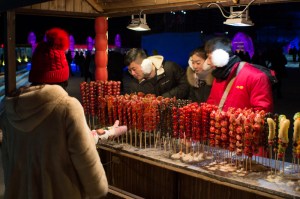
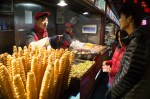
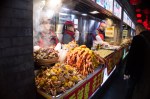
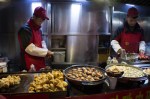
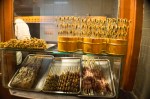
Snack Food Street – a hundred meters of assorted food. From exotic to the outrages. To each his or her own, I guess. There seem to be no place to start or to finish. Just indulge on sight. It was crowded and the bright lights and aromas attracted people like bees to nectar. One problem, although welcomed, is selection – what to eat?
Dongsi area is also a great place for dining and connections on the efficient, but crowded Metro.
From Sichahai, via the wonderful Yan Dai Byway (Skewed Tabacco Pouch Street, we entered the Gulou Dong Dajie. Here lies one of the symbols of the old city, Drum Tower. An imposing pagoda like structure rose against a blue sky at the end of the busy road. Inside the compound, several rickshaw drivers offered Hutong tours. At the other end, is the formidable gray-looking Bell Tower. Hutongs surround this ancient towers. The locals gathered in this convenient large cobbled stoned compound. Some just chatted away with little ones running around.
Both these towers are symbols of the old city. They were built around 1272 during the Yuan dynasty and the capital (Beijing) was named Dadu. They were historically used for telling time during the Yuan, Ming and Qing dynasties. They set the tempo and beat of daily life in Beijing. A small collection of colorful rickshaws gathered at the entrance. They gently persuaded us to take their hutong tours. They were not pushy or aggressive. We just turned down their offers. We wanted to walk through the hutongs at a leisurely pace.
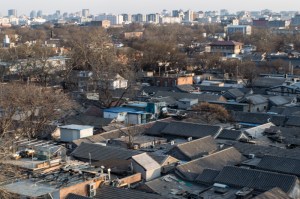
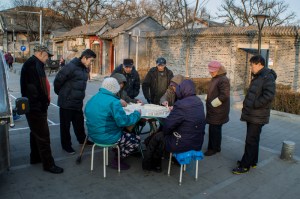
We headed first to the Bell Tower. It is a decent climb up to the top. Albeit the pollution laden air, the views were wonderful. On one end, the towering CBD and nearby, compactly arranged gray roof-tops of the hutongs. This is old Beijing, still preserved in pockets in the heart of modern Beijing. The huge bell, at 57 tonnes, had a rather sad story. The maker tried several times but failed. Eventually, his daughter jumped into the furnace and the finished bell resonated perfectly. We wandered around a park adjacent to the Bell Tower. Adults and kids played badminton and some elderly people played mahjong. We surveyed the area while exercising on some exercise implements.
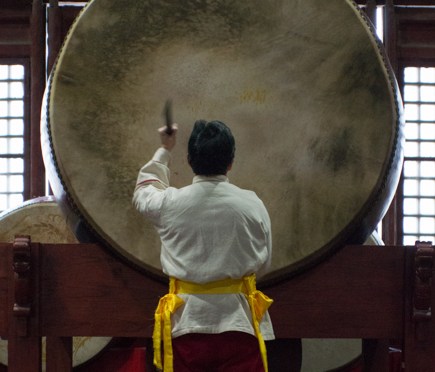
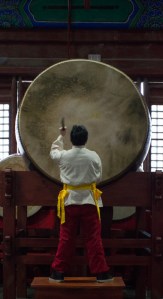
The walk up the steep staircase to the top of Drum Tower was tiring. However, the view from the top was similar to the Bell Tower. Originally, thee were 24 drums but only one had survived. We timed our visit here with the scheduled drum performance. It was interesting and entertaining. It was getting late as we left these ancient towers. We were ready to hit the hutongs, near the northern lake areas.
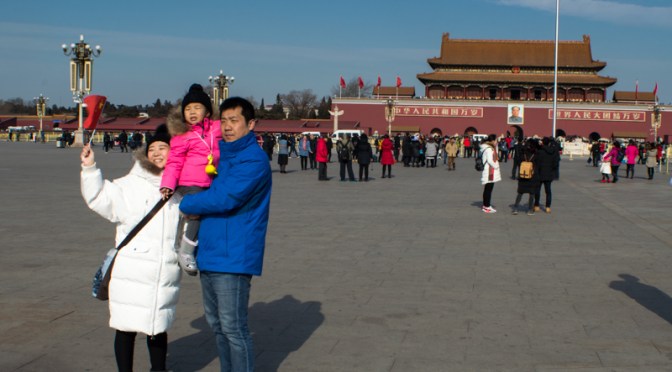
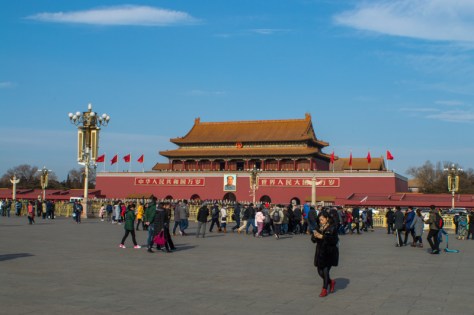
Tiananmen, a name taken from the Gate of Heavenly Peace (at he Forbidden City), is a huge concrete square surrounded by Museums, Mausoleum of Mao Zedong and the iconic Forbidden City. The square had played a significant role for several event in China. However, the most remembered is probably, at least for me, was the 1989 pro-democracy movement and subsequent suppression and massacre by the Communist government. For me, the most vivid memory was the lone man attempting to block a row of tanks form advancing. He was subsequently dragged away by fellow demonstrators.
Today, it was the unusual blue sky with the pollution level reading of 50! It was wonderful to feel the sun on my skin with winter, almost forgotten. Both locals and tourist meandered through the crowds and avoid collision with the uniformed marching soldiers. Parents frantically coxing the young kids to pose with the Forbidden City in the background. Not leaving out the patriotic waving of the Chinese flag. All whom entered into the square are subject to baggage inspection. Safety is paramount, but for whom? I was told by locals that there are many policemen in mufti wandering around, just in case if something undesirable should arise. Close circuit cameras are everywhere. The legacy of Mao Zedong is ever present here, a large portrait, hung on Tiananmen Gate across the street is a prominent sight.
The surrounding buildings, all gray and looked like characterless soviet block buildings. A busy Chang’an Avenue separated the square from the entrance to the Forbidden City. Besides the blue sky, everything here is gray. It was great to see the relaxed faces of the local adults, and kids being kids. It is an open space for the masses to gather freely , mass gathering for the regime, historic events and a great place to people -watch. The control by the authorities is tangible. Furthermore, there is no sitting areas or benches. A must-see place, perhaps. If you are a history buff, Mao’s mausoleum is a must. He is still there for all to see.
We arrived at the Temple of Heaven complex by train which is conveniently located near the East Gate. The air seemed more polluted than yesterday as the gray sky descended onto the land. A two dimensional image – A great wall of gray! The crowds were mainly Chinese tour groups, with tour leaders waving flags and leading the way. This park is about 270 hectares. I like to say it was a breath of fresh air out of the crowded city, but no. Pollution is not only hazardous to health but depressing too. The cold weather did not help either.
The Temple of Heaven complex was constructed from 1406 to 1420 during the reign of Emperor Yongle. The layout of the architecture and location of structures were in line with both Feng Shui and Orient cosmology. It was once part of the walled Imperial City.
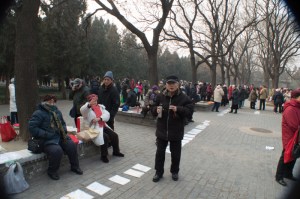
The Seven Star Rocks (seven rock placed on the ground are symbolic of the seven peaks of the Taishan Mountain). Elderly man and women gathered here under tall leafless trees. Initially, I thought they were dancing or having a chat. I soon noticed sheets of paper on the ground. Some with pictures of young man and women with specifications like height, age, academic qualifications, occupation and so on. This is a non-digital match-making site. Some people were unhappy with my intrusion but soon ignored as the realized that I was just a foreigner passing through. This is serious business judging from the intense but quiet discussions and scrutiny of the documents. With China modernizing rapidly and young people chasing their dreams of better lives, there is little time to ponder about romance and marriage. A girl over 28 years old is considered ‘old’. This is further divided between educated and non-educated; rural and urban young people. There are actually eight rocks, the last one added by Emperor Qinlong.
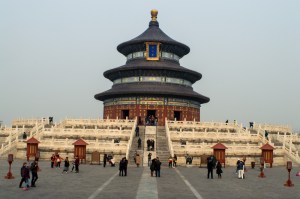
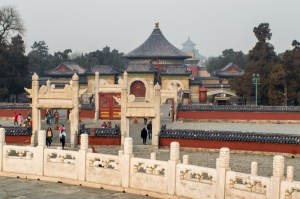
Hazy view of the Hall of Prayer for Good Harvest appeared at the end of a long corridor with many doors. The locals gathered here for a chat, play chess and card games. It was quite social and people seemed relaxed and enjoying the moment. Through a gate, we entered the Hall of Prayer for Good Harvest complex. Even though it was hazy, the elevated circular Hall was impressive with vivid colors. Two buildings on either side balanced the complex. Three circular tiers made from marble complete with balustrades and railings is the base for the 32m circular and colorful Hall. In the middle of the stairway is a wonderful marble engraving of clouds, dragons and phoenixes. It was very regal. The majestic Hall is made entirely from wood with no beams, crossbeams or nails. The upper surface is decorated with blue glazed tiles, inter-painted with red and yellow. The top of the structure is crowned with a gilded ball. I squeezed past the crowded entrance to get a glimpse of the interior. It was very impressive indeed. Massive pillars painted red and decorated with dragons, phoenix and paintings supported three layers of richly decorated web-like ceilings.
This Hall of Prayer for Good Harvest is significant as the “Sons of Heaven’, the Chinese Emperors came to worship the Heavens’ for a good harvest at winter solstice. Sacrifices are also made here to please the heavens. The structures and arrangements are precise – The circular hall on a square base symbolizing heaven and earth respectively. This is perhaps the Chinese axis-mundi, center of earth!
Further north is the Echo Wall. An interesting structure with three buildings. A circular wall built around this complex echo’s every word to the opposite side of the wall. It helps when it is less crowded. It really works. Excitement as well as amazement showed on the faces of those whom participated.
At the southern end of the temple complex is the Circular Altar built on three tiers – representing Earth, the mortal world and heaven. Each platform is decorated with marble dragon carved guard rails. At the center is a flat rounded stone, Heart of Heaven. I stood on this stone and uttered these words – let there be peace in the world. I was astonished that the sound reflected off the guard rails created an enhanced resonance. Amazing!
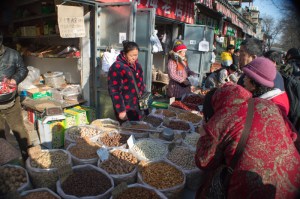
Pines and cypress occupied large parts of the garden. In one building, elderly ladies, dressed in colorful costumes, danced to some lovely music. We finally exited through the West Gate. Just outside the exit are hutongs. On one streets, a busy market was in full swing selling an assortment of food items including dried fruits and nuts, and pastries. A must visit site in Beijing.
The Great Wall of China is not a single wall but a series of walls built over a period of time. They are connected at various points. The earliest wall were built warring feudal states as a protective boundary. The first Emperor, Qin Shi Huang, whom united China, ordered further construction around 220BC. The wall near Beijing were mainly build during the Ming Dynasty, to protect against northern invaders. Originally built with gravel and earth, bricks and mortar were later used to fortify the walls. The width and height varies along the walls. Today, it is estimated to be over 21000 km! The largest man made structure. Jiànkòu and Mùtiányù sections were constructed during the Ming era, about 1300. Some sections were just fortification of older walls.
I anticipated that it would be very cold up here in the mountains. Pleasantly surprising, it was manageable. We continued further. There were no other footprints on the snow covered ground. In some places on the crumbled wall, woody shrubs made walking tough. Sometimes walking on the edges with bricks and paving stone loosely accumulated on the uneven ground. Again, the ‘snow nails’ on our shoes helped us tremendously.
Finally we a reached a crumbling small tower. The path past here was a steep ascent and carved out a semi-circle loop with a even steeper decent. Leo offered an alternative, to cut across the valley and continue back on the wall. This is the Ox Horn Edge Wall. Considering that we had slight difficulty over some previous descents, we opted to give this part a miss and rejoin on the other side. This leg of the hike would take about two hours ( estimate 2km). Along this new path, we found some paw prints in the snow. Perhaps foxes or perhaps just local dogs.
Jiankou to Mutianyu Hike – Ox Horn Edge
The distant views were still hazy due to the persistent smog. The height of the wall continually rose and dropped with the terrain. Hikers from Mùtiányù section passed us wondering how far they needed to go (perhaps to Xizhazi Village). This was our first contact with anyone since the man at Zhengbeilou. The cold and slippery surfaces made parts of the hike treacherous. One hiker literally sat on her bum and slide down steep descends. We soon reached the beginning and restored wall of Mùtiányù section, Tower 23 around 11pm. It has taken us about an hour to get here from Zhengbeilou. An industrious man had set up a small stall with some basic snacks. Red ribbons hung on trees perhaps for good fortune.
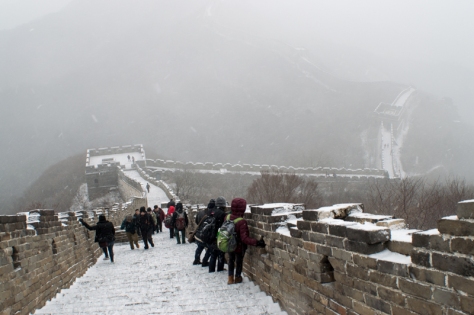
We continued to hike over smooth paved stones, with a few other hikers coming from Mùtiányù entrance. Everything was tidy, both the walls and walking surfaces. Almost sterile. The walls climbed and descended as it crawled over the mountains. Snowfall continued a the views ever-changing. We descended down on some steeps steps and reached the walled entrance of Tower 20 around 1145. This was was put up by the government to indicate the the sections we had just hiked is off limits to the public. We climbed onto a narrow ledge and jumped across a low wall. However, one slip, it is a long fall! This is the restored section of the wall. The stones used here are granite. The wall stretched zigzagging through the mountains. Towers popped up at intermittent breaks. The concentration of towers seem more that in Jiànkòu section.
Jiankou to Mutianyu Hike – Tower 20Jiankou to Mutianyu HikeJiankou to Mutianyu Hike
Although restored, the surface was slippery. Furthermore, the snow and steep elevation compounded the problem. Those with spikes were steady. Alternatively is the cling to the wall and move slowly. From tower to tower, we too moved slowly like the crawling snake. At places, the walking surface is smooth and in some stone steps. As it is winter time, there were very few people walking on the wall. This suited me fine. At Tower 14, there is an exit by taking the cable car down the hill. We continued our hike until Tower 6 before descending to the main entrance of the Mùtiányù section. It was around 1315. We had hike the sections for about 4 hours.
Our transport picked us up and head to a local restaurant. We were all hungry and tucked in our lunch rather quickly. It was still snowing as we left the area and headed back to Beijing. Leo had been great. Welcome back to chaos and the din of a Chinese city. This had been, despite the heavy smog above in the mountains, one of the satisfying experiences of an iconic structure. Hiking on the wild sections had been a wonderful experience – the rugged natural beauty of an ancient and crumbling wall; with very little interference from other people and finally hiking with my family.
Hiking the unrestored Jiànkòu section had given us the raw beauty and the difficulty that comes with hiking the crumbling walls and undulating, sometimes steep climb and decent, terrain; the isolation (there was no one on this trail today until we reached nearer to Tower 23); and a sense of adventure. Finally, there is a sense of being present with the workers who built these walls and towers long ago. Their work untouched by restoration. Only encroached and etched away by nature if continued to be left alone. This is something to see, touch , feel and witness.





































 Intrepid Nomad - Travel Tales and Stories